

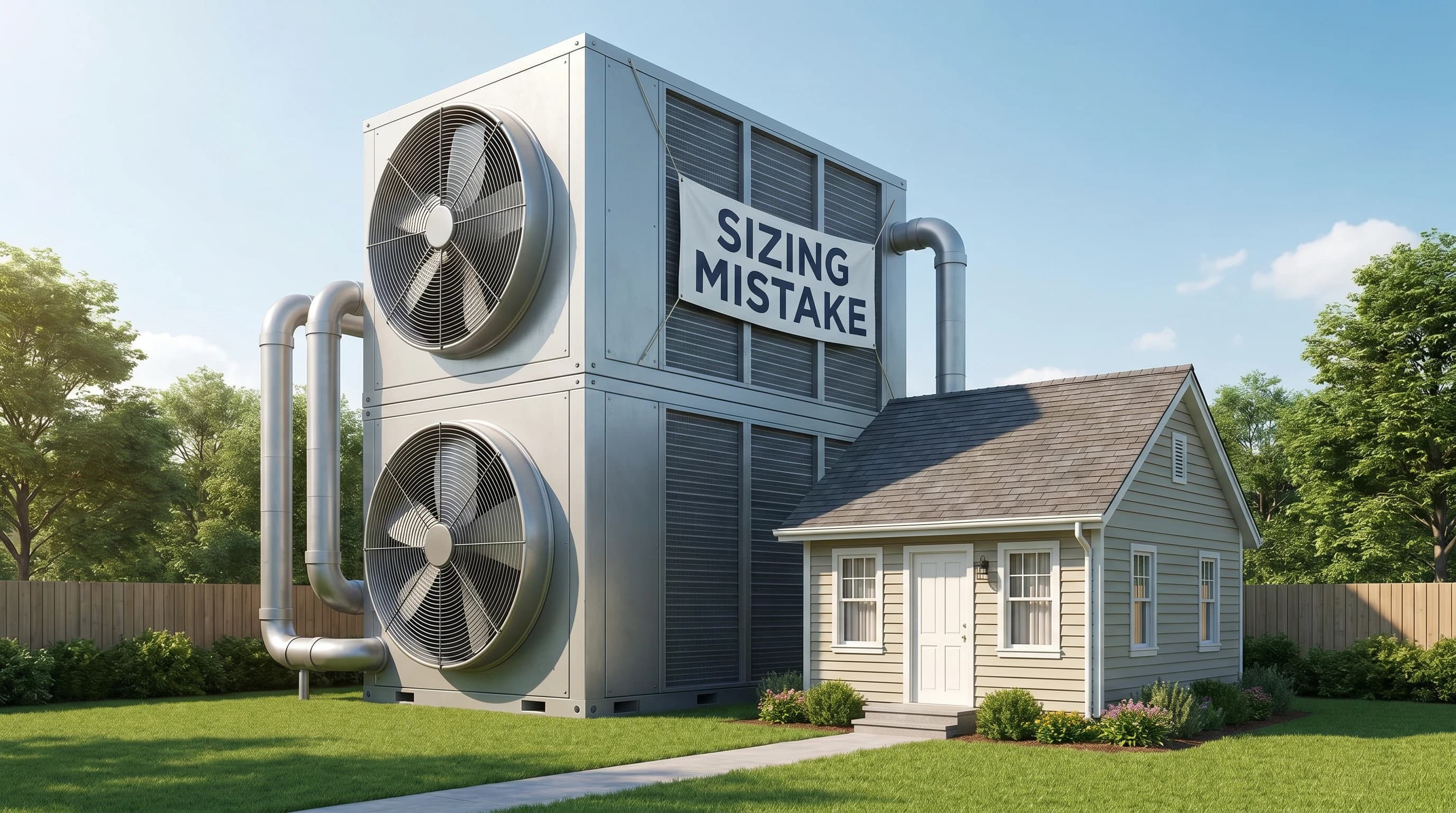
5 HVAC Sizing Mistakes That Cost Homeowners Thousands in 2026
Quick Answer: 5 HVAC Sizing Mistakes That Cost Homeowners Thousands in 2026
Key Takeaways
- The "500 sq ft per ton" rule fails in over 70% of modern homes.
- An oversized AC unit can waste $400-$800 per year in electricity costs due to short-cycling.
- A proper Manual J load calculation is the only way to prevent expensive equipment sizing mistakes.
- Your home's insulation and window quality can change the required AC size by 30-40%.
- Always get at least three quotes and compare the recommended equipment tonnage and sizing reports.
Choosing a new HVAC system is one of the biggest financial investments you’ll make in your home. Yet, a widespread industry problem leads thousands of homeowners to install improperly sized systems that cost them dearly in comfort, energy, and equipment lifespan. This "Tonnage Trap" is caused by a reliance on outdated rules of thumb instead of modern engineering. This guide will walk you through the most critical HVAC sizing mistakes and arm you with the data needed to protect your investment.
Mistake #1: The "500 Square Feet Per Ton" Myth
The most pervasive and damaging mistake is relying on an oversimplified "rule of thumb." This method assumes that every home has the same thermal properties. It ignores the most critical elements of modern building science. A modern, well-insulated 2,500 sq. ft. home might only need a 2.5-ton AC unit, while an older, leakier home of the same size could require a 5-ton unit. Relying on square footage alone is a gamble that ignores your specific R-values, window U-factors, and air leakage rates.
Mistake #2: The "Bigger is Better" Fallacy
Homeowners often believe that a 5-ton unit will cool a house faster and better than a 3-ton unit. While a bigger unit will lower the air temperature faster, it fails to perform the AC's second job: Dehumidification. An oversized air conditioner will run in short, powerful bursts (short-cycling). It hits the thermostat target in 8 minutes and shuts off. This isn't long enough for the coil to get cold enough to remove moisture from the air. You end up with a house that is 70°F but has 70% humidity—the classic "cold and clammy" feeling that leads to mold and discomfort.
Mistake #3: Envelope Neglect
Your HVAC system doesn't heat or cool "the house"—it counteracts the heat gain and loss of your Building Envelope. A contractor WHO gives you a quote without looking in your attic or checking the seals on your windows is guessing. If you spend $1,000 on air sealing and insulation before you buy your HVAC, you can often step down an entire size in equipment (e.g., from a 4-ton to a 3-ton), saving you thousands on both the installation and the monthly utility bills.
| Sizing Mistake | Financial Impact | Comfort Impact |
|---|---|---|
| Oversized Unit | +$400/yr in energy | Cold & Clammy / Noisy |
| Undersized Returns | Early Blower Failure ($1200) | Hot/Cold Spots |
| Mismatched Coils | Voided Warranty / Low SEER | Inconsistent Performance |
Mistake #4: Ignoring the Return Air System
Airflow is a loop. If your AC can't "breathe" in enough air, it can't blow enough out. Many contractors install a new, powerful blower but leave the original, undersized return duct and grill. This is like trying to run a marathon while breathing through a cocktail straw. It creates high Static Pressure, which leads to noisy vents, frozen coils, and a blower motor that burns out in 5 years instead of 15. A proper sizing audit must include a Manual D duct analysis.
Mistake #5: Mismatched Components (The "Swap-Out")
When an outdoor unit (condenser) dies, some homeowners try to save money by only replacing the outdoor part while leaving the old indoor coil. This is a critical mistake for modern high-efficiency equipment. New 16+ SEER2 units require significantly larger indoor surface areas and specific Expansion Valves (TXVs) to achieve their efficiency. Mixing an old R-22 coil with a new R-410A or R-32 condenser will result in a system that is inefficient, unreliable, and almost certainly has no manufacturer warranty.
Mistake #6: Ignoring Climate Zone Design Temperatures
An AC system should be sized for the Design Temperature of your specific location, not the record high. If you live in a region where it hits 100°F once every five years, but usually stays at 92°F, sizing for 100°F will leave you with an oversized unit for 99% of the summer. Professional Manual J software uses localized climate data to ensure the unit is large enough for the heat, but small enough to dehumidify effectively. Sizing for the "worst case scenario" in history is a guaranteed way to have a system that underperforms for the rest of its 15-year life.
Mistake #7: Thinking "Variable Speed" Fixes Oversizing
Many contractors will try to upsell you to a high-end, variable-speed (inverter) unit, claiming that because it can ramp down its capacity, the initial size doesn't matter. While it's true that a variable-speed unit is more forgiving of slight oversizing, it is not a magic fix for a gross error. A 5-ton variable speed unit usually has a minimum "turn-down" ratio. If your home only needs 1 ton of cooling on a mild day, even that 5-ton unit ramped down to its lowest setting might still be pushing 2 tons of cooling. It will still short-cycle, it will still be less efficient than a correctly sized unit, and you will have spent thousands of dollars extra on technology that your home can't actually utilize. Sizing is still the most important step, even with the most advanced equipment on the market.
Mistake #8: The "High MERV" Filter Trap
Homeowners often want the cleanest air possible and buy the thickest, most restrictive HEPA-style filters they can find. If your system was sized and your ducts were designed (Manual D) for a standard fiberglass filter, adding a high-MERV pleated filter can reduce your airflow by 20% or more. This creates the same symptoms as an undersized unit: frozen coils, high energy bills, and a dead blower motor. A proper sizing audit should consider the Pressure Drop of the specific filtration system you intend to use to ensure the blower can handle the load.
The One Question to Ask
How to Protect Your Investment
The key to avoiding these mistakes is independent verification. Before you call a single contractor, use our HVAC Load Calculator to establish a baseline. If our tool suggests you need 2.5 tons, and a contractor tries to sell you 4 tons without a detailed explanation, you have the data needed to push back.
Official Sources & Resources
Frequently Asked Questions
About the Author: Jameson Miller
Jameson Miller has over 15 years of experience in the home construction and finance industries. As a lead consultant for major residential projects and a certified financial analyst, he specializes in making complex home improvement decisions simple and data-driven. His work ensures that HomeCalc Pro provides homeowners with the most accurate, industry-standard calculations available today.