

Duct Size Calculator
A free HVAC duct sizing calculator to determine the proper duct diameter for your system based on airflow (CFM). Ensure optimal performance. Professional-grade accuracy for your home projects.
How to use this calculator
Ensure efficient airflow in your HVAC system by calculating the correct duct size. This is a simplified tool and requires technical inputs like Air Flow (CFM) and Friction Loss Rate, which are typically determined by a full HVAC load calculation (Manual J).
Share This Professional Calculator
Found this helpful? Share it with your network to assist them with their home improvement projects.
Expert Guide to Duct Size
Plan your project with precision using our 2026 standardized calculator.
Step-by-Step Instructions
- 1
Step 1: Determine Required CFM
Use a Load Calculator to find the CFM needed for the specific room (Standard: ~1 CFM per square foot).
- 2
Step 2: Select Friction Rate
Standard residential design typically uses a friction rate of 0.1 or 0.08 inches of water column per 100 feet of duct.
- 3
Step 3: Choose Duct Shape
Select from Round (most efficient) or Rectangular (for tight spaces between joists).
- 4
Step 4: Define Velocity Limit
For quiet operation, keep air velocity below 600-700 feet per minute (FPM) in branch ducts.
- 5
Step 5: Review Dimensions
The tool provides the required diameter for round pipe or the width/height for rectangular trunk lines.
Pro Tips & Analysis
The most important technical concept in ducting is Static Pressure. Think of static pressure like blood pressure; if it is too high, it puts immense strain on the HVAC blower motor, leading to premature failure. Every elbow, tee, and register in your duct system adds "Equivalent Length" and increases static pressure. Our calculator assumes a standard residential friction rate, but for long duct runs, you must increase the duct diameter to compensate for this resistance. Professionals always measure "Total External Static Pressure" (TESP) with a manometer to ensure the duct system matches the blower's performance curve. Our tool providing the diameter is the starting point, but a straight, well-supported duct path is what ensures the air actually reaches its destination.
Another vital consideration is Air Velocity and Noise. Velocity is how fast the air is moving inside the duct. If air moves too fast (over 900 FPM), it creates turbulent noise and "whistling" at the grills. If it moves too slow (under 400 FPM), it won't have the "throw" needed to mix the air in the room, leading to a hot layer at the ceiling and a cold layer at the floor. Our calculator helps you find the "sweet spot" where air is moving fast enough to be effective but slow enough to be silent. Finally, remember the Sealing and Insulation. Even a perfectly sized duct is useless if it leaks 30% of its air into an unconditioned attic. Professionals use "Mastic" or "Foil Tape" (not standard duct tape) to seal every joint. Insulating ducts in unheated spaces is also mandatory by code to prevent condensation and energy loss. Our tool gives you the size, but your attention to these "airtightness" details is what makes the system professional-grade.
Scientific Calculation Methodology
Duct sizing is based on the Darcy-Weisbach equation, simplified for HVAC using Friction Rate and CFM.
Area (sq ft) = CFM / Velocity; Diameter = sqrt((Area * 4) / pi)
Practical Example:
For 150 CFM at 0.1 friction: a 6" round duct is on the limit, but a 7" duct is ideal for low noise.
Achieving Precision Results
1
Use "Long Radius" elbows whenever possible; a sharp 90-degree turn is equivalent to adding 30 feet of straight pipe.
2
Never use "Duct Tape" for sealing; it will dry out and peel off within a year. Use UL-181 rated foil tape or brush-on mastic.
3
Install a "Manual Volume Damper" in every branch duct so you can "balance" the system after installation.
4
If using flex duct, ensure it is pulled tight; every "sag" or "kink" doubles the airflow resistance.
5
Keep your return air ducts 20% larger than your supply ducts to ensure the furnace blower is never starved for air.
Technical Fast Facts
- ✓Manual D is the industry standard for residential duct system design.
- ✓Flexible ducts should be fully extended; every 4% of compression doubles friction.
- ✓Static pressure is the "blood pressure" of your HVAC system.
- ✓Return ducts should be sized at least 20% larger than supply ducts for quiet operation.
- ✓Undersized ducts lead to "noisy" systems and premature blower motor failure.
Expert Q&A
Explore Related Tools
Precision tools to complement your current calculation.
HVAC Load
Free Manual J load calculation. Get accurate BTU requirements for your home to choose the right size furnace and AC system. Avoid costly mistakes.
hvac heating cooling
AC Size (BTU)
Find the perfect air conditioner size. Our BTU calculator helps you determine the right cooling capacity for any room based on size and conditions.
hvac heating cooling
SEER Savings
Estimate your annual savings by upgrading to a high-efficiency AC unit. See your potential cost reduction and payback period with a new SEER2 system.
hvac heating cooling
Mini-Split Cost Estimator
Get a budget estimate for a new ductless mini-split system. Find the installed cost for a single-zone or multi-zone setup for your home.
hvac heating cooling
In-Depth Guides
Expert insights and advice to help you make informed home decisions.
Read Article
HVAC 5 Min Read
HVAC Sizing Guide 2026: Stop Guessing, Start Calculating
The definitive guide to sizing your air conditioner and furnace in 2026. Learn why the '500 sq ft per ton' rule is obsolete and how Manual J calculations ensure perfect sizing.
Read Article
HVAC 5 Min Read
What is AFUE? Understanding Furnace Efficiency Ratings
A complete guide to AFUE (Annual Fuel Utilization Efficiency). Learn what the percentage means, the difference between 80% and 95% furnaces, and how to choose the right one in 2026.
Read Article
HVAC 5 Min Read
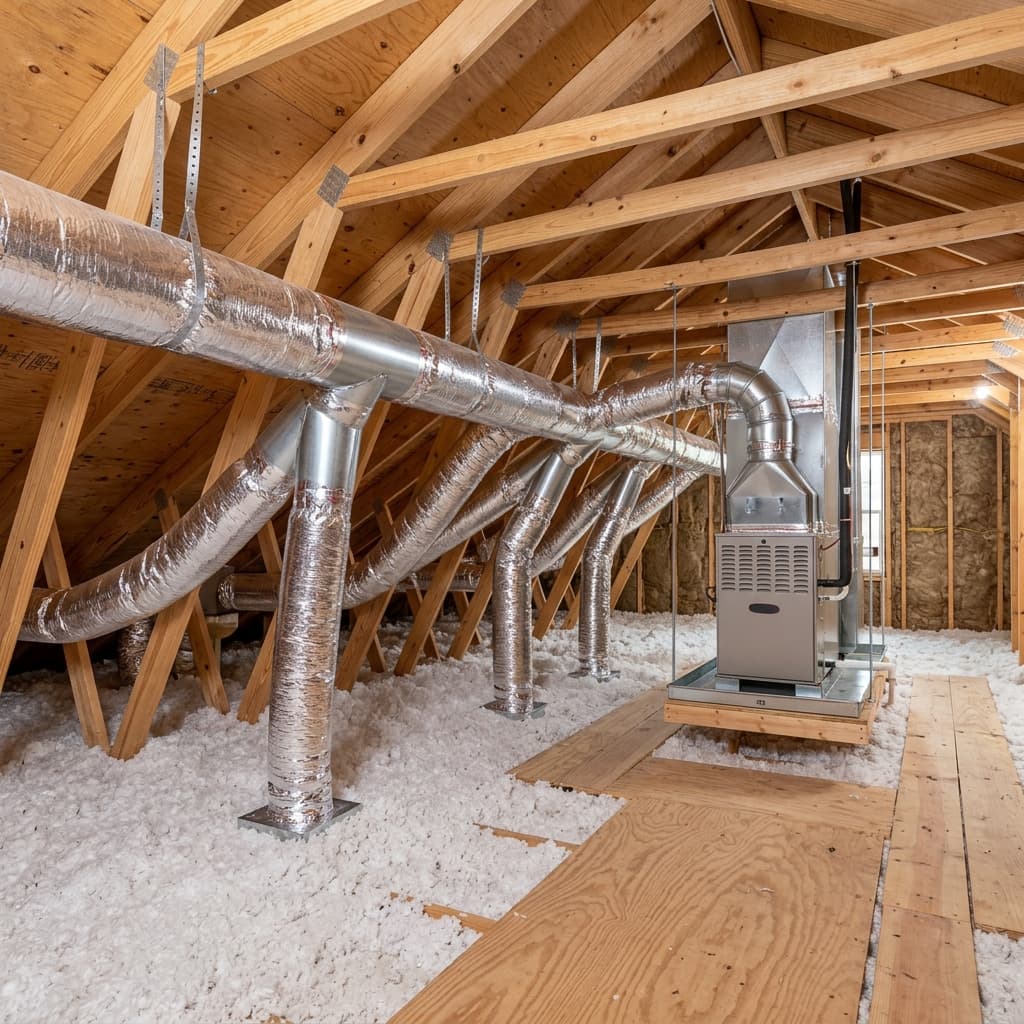
Ductwork Design (Manual D): The Unseen Key to HVAC Performance
Your HVAC system is only as good as its ductwork. Learn what ACCA Manual D is, why it's critical for airflow, and how improper ducts waste thousands in 2026.