

Insulation R-Values: What They Mean in 2026
Quick Answer: Insulation R-Values: What They Mean in 2026
Key Takeaways
- R-Value is a measure of thermal resistance—the higher the number, the better the insulation's ability to stop heat flow.
- R-value is determined by the material type (e.g., foam, fiberglass) and the thickness of the installation.
- The required minimum R-value is strictly mandated by the IECC based on your specific DOE Climate Zone (e.g., Zone 6 requires much higher R-values than Zone 2).
- Proper insulation reduces the workload on your HVAC system, directly lowering your Manual J load calculation and your monthly energy bills.
- Missing R-value targets is the fastest way to render a brand-new, high-efficiency AC or furnace useless.
Introduction: The Shield That Protects Your Wallet
You can buy the most efficient, expensive HVAC system in the world—a 26 SEER2 super-inverter—but if your home has poor insulation, you are effectively trying to cool a tent with the zipper open. Heat will always move from a hot place to a cold place, and it moves fast. Insulation is the only barrier standing in its way.
For standard homeowners, insulation is often "out of sight, out of mind" in the attic or behind drywall. But this invisible layer is the single most important factor in determining your monthly energy bills, your home's comfort, and even the lifespan of your heating and cooling equipment.
At the center of all insulation decisions is the R-Value. It is the yardstick by which we measure a material's effectiveness. But R-value is not just a number on a pink package; it is a complex calculation that involves physics, climate science, and proper installation technique.
What is R-Value? The Physics of Resistance
R-Value measures a material's thermal resistance, or its ability to resist the conductive flow of heat. The "R" stands for Resistance.
In simple math:
It acts like a break for heat. During winter, R-value stops the heat your furnace creates from escaping through the ceiling. During summer, it stops the intense radiant heat of the sun (which can reach 140°F in an attic) from pushing down into your living space.
R-value is cumulative. If you have a layer of R-19 fiberglass and you add another layer of R-19 on top, you now have roughly R-38. This allows homeowners to upgrade their efficiency simply by adding "more fluff" to their attics.
How Heat Moves (And Why Conductive Resistance Matters)
To understand R-value, you must understand the enemy: Heat Transfer. Heat moves in three ways:
- Conduction: Heat moving through solid materials (like a spoon in coffee). R-Value specifically measures resistance to conduction.
- Convection: Heat moving through air flow (drafts). While standard insulation slows this, air sealing is the real cure for convection.
- Radiation: Heat moving as energy waves (like the sun). Radiant barriers (shiny foil) address this, but standard insulation largely absorbs it.
Because R-value focuses on conduction, it is critical to also address air sealing. If air can bypass your insulation through gaps and cracks, the R-value becomes irrelevant. It's like wearing a thick wool coat (high R-value) but leaving the zipper open (air leak).
R-Value Requirements by Climate Zone: A State-by-State Analysis
The Department of Energy (DOE) breaks the United States into 7 distinct Climate Zones, plus sub-zones for moisture levels. The amount of insulation you need is not a suggestion; it is legally mandated by the International Energy Conservation Code (IECC). Choosing an R-value that falls below your zone's requirement can result in building inspection failure and, more importantly, a lifetime of unnecessarily high utility bills.
Zone 1 & 2: The Tropical and Subtropical South
Covering southern Florida, southern Texas, and Hawaii, Zone 1 is the hottest region in the US. Zone 2 includes the remainder of Florida, southern Georgia, the Gulf Coast, and parts of Arizona. In these regions, the primary thermal challenge is Radiant Heat Gain. The sun bakes the roof deck, which then radiates heat into the attic. If your attic is under-insulated, this heat pushes down into your ceiling and into your living spaces, forcing your air conditioner to run almost constantly.
- Attic Target: R-30 to R-38. While code may allow R-30, R-38 is the recommended "efficiency" level.
- Wall Target: R-13 to R-15. Many homes in these zones use concrete block construction, which requires specialized rigid foam or furring-strip insulation to meet these targets.
- Floor Target: R-13. Necessary if you have a crawlspace or a room over an unconditioned garage.
Zone 3 & 4: The Mixed-Humid Middle
This "Goldilocks" zone includes much of the Mid-Atlantic, the Deep South, and the lower Midwest (e.g., North Carolina, Tennessee, Missouri, and Virginia). These areas experience both hot summers and freezing winters. This means your insulation must be a "two-way player"—keeping heat in during January and pushing it out in July.
- Attic Target: R-38 to R-49. Most new construction in these zones is moving toward R-49 as the standard.
- Wall Target: R-13 to R-21. For 2x4 framing, R-15 is common; for 2x6 framing, R-21 is the standard.
- Floor Target: R-19 to R-25. Floor insulation becomes much more critical here as the ground temperature drops significantly in winter.
Zone 5, 6, & 7: The Cold Northern Tier
Covering the Pacific Northwest, the northern Midwest, and New England (e.g., Minnesota, Maine, Montana, and New York), these zones are dominated by the need for Heating Retention. When it is 10°F outside and you want it to be 70°F inside, you are maintaining a 60-degree "Delta T" (temperature difference). This extreme pressure wants to pull every bit of heat out of your home.
- Attic Target: R-49 to R-60. In Zone 7 (the coldest parts of the US), R-60 is often required to prevent massive heat loss and the formation of destructive ice dams.
- Wall Target: R-21 to R-30. Many northern builders now use "Continuous Insulation" (rigid foam on the outside of the studs) to reach these high targets.
- Floor Target: R-30+. Basement and crawlspace insulation is vital to prevent frozen pipes and cold feet.
R-Value by Insulation Type: Choosing the Right Material
Not all insulation is created equal. An inch of spray foam is nearly twice as effective as an inch of blown fiberglass. Choosing the right material is a balance between your target R-value, your project budget, and the physical constraints of your home.
Fiberglass (The Budget Standard)
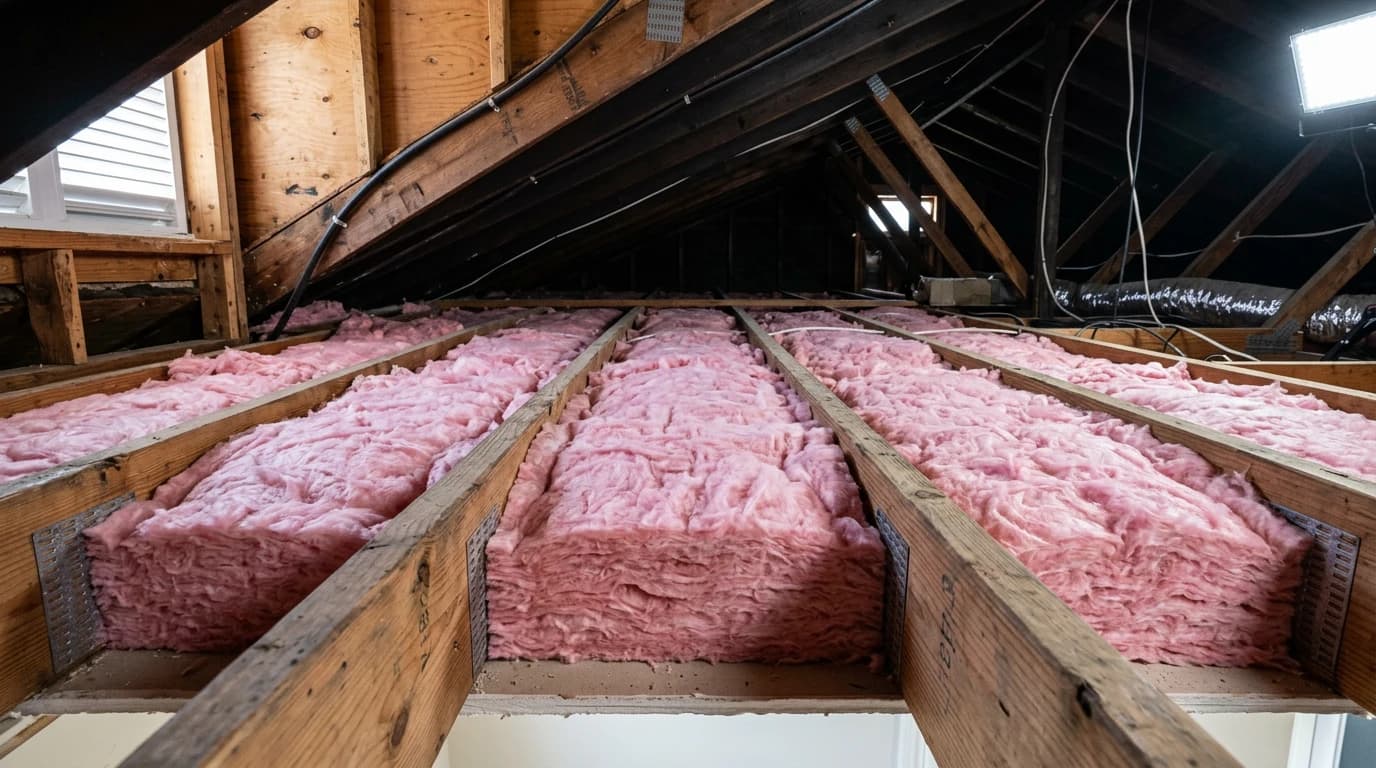
Fiberglass is made from recycled glass and sand melted and spun into fibers. It is available as "Batts" (rolls) or as loose-fill for blowing. Fiberglass is naturally fire-resistant and relatively inexpensive. However, its R-value per inch is the lowest of all common materials (approx. R-2.5 to R-3.4). To reach R-60 with fiberglass, you would need nearly 20 inches of material, which can be difficult to fit in some attic designs.
Cellulose (The Eco-Friendly High Performer)
Cellulose is made from 80-85% recycled newspaper treated with boric acid for fire and pest resistance. It has a higher R-value per inch (approx. R-3.5 to R-3.8) than fiberglass. More importantly, cellulose is much denser than fiberglass, meaning it is much better at stopping air infiltration. It doesn't just resist heat; it blocks drafts. This makes it a professional favorite for "topping off" older attics.
Spray Foam (The Premium Solution)
Spray foam is a two-part liquid that expands into a solid. Open-cell foam (R-3.5/inch) is great for soundproofing and wall cavities. Closed-cell foam (R-6.5 to R-7.0/inch) is the gold standard of insulation. It acts as a thermal barrier, an air barrier, AND a vapor barrier all in one. It also adds structural strength to your walls. While it is 3 to 4 times more expensive than fiberglass, the energy savings are often 20% higher because it eliminates air leaks entirely.
| Material | R-Value / Inch | Best Application | Pros & Cons |
|---|---|---|---|
| Fiberglass Batts | 3.1 – 3.4 | Walls, Floors, Attics | Pro: DIY friendly, inexpensive, widely available Con: Itchy to handle, ineffective if compressed, gaps ruin performance |
| Loose-Fill Fiberglass | 2.2 – 2.7 | Attics (blown-in) | Pro: Fills irregular gaps well, fast installation Con: Can settle over time, requires machine rental |
| Cellulose (Blown-in) | 3.2 – 3.8 | Attics, Wall Cavities | Pro: High recycled content, better air blocking than fiberglass, fire resistant Con: Dusty installation, absorbs moisture if not sealed |
| Open-Cell Spray Foam | 3.5 – 3.8 | Roofed Decks, Walls | Pro: Expands 100x, excellent air barrier, sound dampening Con: Expensive, not a vapor barrier, requires pro install |
| Closed-Cell Spray Foam | 6.0 – 7.0 | Basements, Thin Walls | Pro: Highest R-value per inch, acts as vapor barrier, adds structural strength Con: Very expensive, difficult to remove |
| Rigid Foam (XPS/Polyiso) | 5.0 – 6.5 | Exterior Sheathing, Slabs | Pro: High R-value, moisture resistant Con: Must be cut precisely, joints must be taped |
| Mineral Wool (Rockwool) | 3.0 – 3.3 | Walls, Fire_stops | Pro: Fireproof, water repellent, excellent soundproofing Con: More expensive than fiberglass, heavier |
The Law of Diminishing Returns
Is more always better? Yes, but only to a point. The R-value scale is not linear in terms of savings.
- Going from R-0 to R-10 stops 90% of heat transfer. (Huge Savings)
- Going from R-10 to R-20 stops another 5%. (Good Savings)
- Going from R-40 to R-60 might only stop another 1% of heat transfer.
This is why we don't insulate our attics to R-100. The cost of the material eventually outweighs the few dollars of energy saved. For most US homes, the "sweet spot" is between R-49 and R-60. Beyond that, your money is better spent on air sealing or upgrading windows.
Common Installation Mistakes: Why Your R-Value Might Be Lying to You
The rating printed on a bag of insulation is the "Potential R-Value." It assumes a laboratory-perfect installation. In the real world, sloppy technique can reduce your effective R-value by 30% to 50% without you ever realizing it.
1. The Compression Trap
This is the #1 mistake in DIY insulation. Homeowners often think that "more is better," so they stuff an R-19 batt into a thin wall cavity meant for an R-13 batt. Insulation works by trapping microscopic air pockets; when you compress the material, you squeeze out the air. Instead of having "extra strength," you have effectively turned your high-end insulation into a dense piece of fabric that conducts heat quickly. Never smash insulation to make it fit.
2. The Thermal Bridging Effect
R-value only measures the resistance of the insulation itself. But your walls are made of wood or metal studs, which have a much lower R-value (wood is approx. R-1 per inch). These studs act as "thermal bridges," allowing heat to bypass the insulation and escape. This is why a wall filled with R-15 insulation might only have a "Whole Wall" R-value of R-11. Professionals solve this by using Continuous Insulation (rigid foam boards) over the studs to "break" the bridge.
2. Gaps and Voids
Insulation must be contiguous. A 5% gap in your insulation coverage can result in a 50% drop in effective thermal resistance. If you cut batts too short or leave gaps around electrical boxes, heat will tunnel through those paths (thermal bridging).
3. Covering Soffit Vents
In attics, you must preserve airflow from the soffit vents to the ridge vent. Amateurs often stuff insulation deep into the eaves, blocking the fresh air intake. This traps moisture in the attic, leading to mold and "ice dams" in winter, which can destroy your roof.
The Future of R-Value: Passive House Standards
As energy costs continue to rise and building codes become stricter, many forward-thinking homeowners are looking beyond the IECC minimums and toward Passive House standards. A Passive House is designed to require virtually no active heating or cooling, relying instead on extreme levels of insulation and airtightness.
In a Passive House design, attic R-values often reach R-80 to R-100, and wall R-values are frequently R-40 to R-60. While these numbers seem extreme today, they represent the eventual direction of residential construction. By investing in higher R-values now, you are "future-proofing" your home against rising energy prices and increasing its eventual resale value to energy-conscious buyers.
Final Thoughts: The Invisible Investment
R-value is the currency of energy efficiency. By understanding it, you can make smarter decisions about where to invest your home improvement budget. Before you buy a new AC, before you buy new windows, or before you install a solar array, look at your insulation. It is the only part of your home that works for you 24 hours a day, 365 days a year, with zero mechanical parts to break and zero maintenance required.
A few hundred dollars spent adding blown-in cellulose to an under-insulated attic can often lower your utility bills more than a $10,000 window replacement package.
Sources
Frequently Asked Questions
About the Author: Jameson Miller
Jameson Miller has over 15 years of experience in the home construction and finance industries. As a lead consultant for major residential projects and a certified financial analyst, he specializes in making complex home improvement decisions simple and data-driven. His work ensures that HomeCalc Pro provides homeowners with the most accurate, industry-standard calculations available today.