

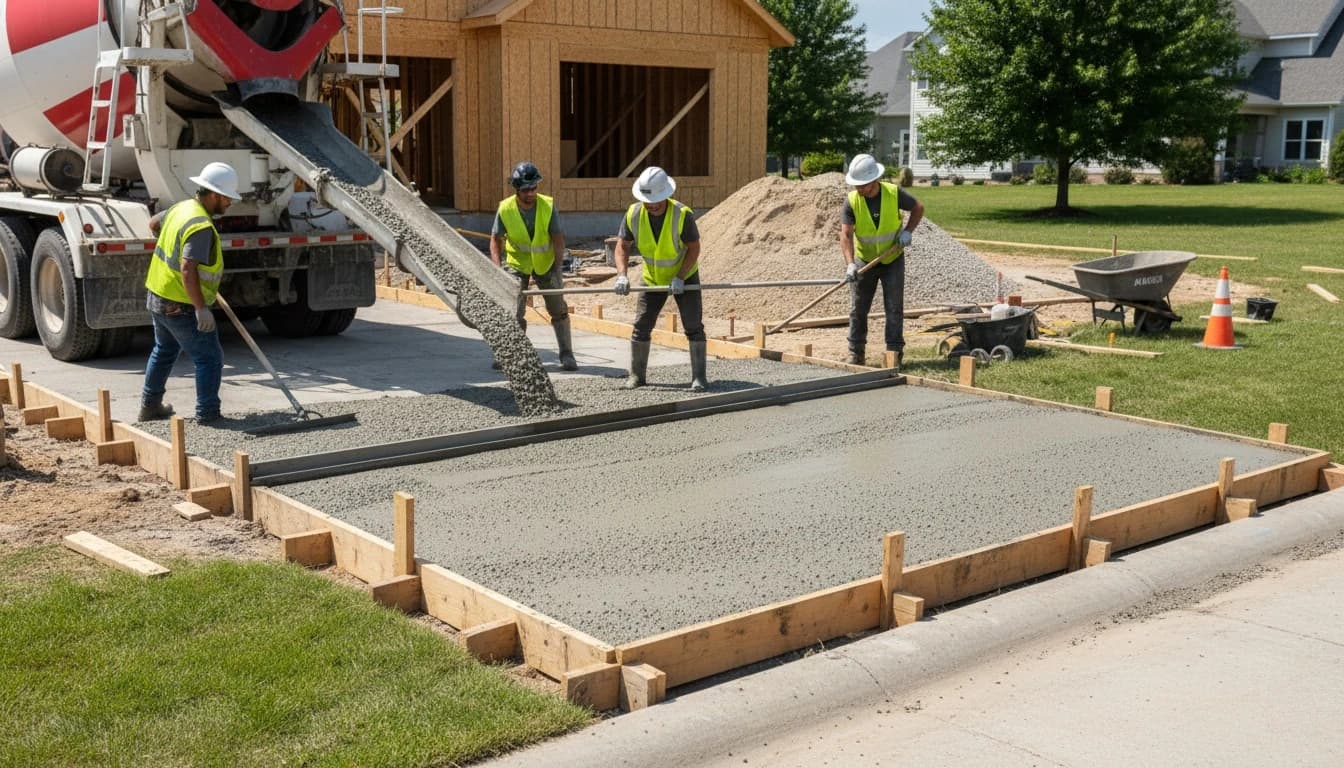
How to Calculate Concrete: The Ultimate 2026 Material Guide
Quick Answer: How to Calculate Concrete: The Ultimate 2026 Material Guide
Key Takeaways
- Always add a 10% waste factor to account for subgrade irregularities and form bulging.
- It takes 45 bags of 80lb pre-mix concrete to equal one cubic yard.
- For driveways, a 6-inch thickness is required to support vehicular weight.
- Ready-mix delivery is usually more cost-effective for projects over 1 cubic yard.
- Proper curing (keeping it damp for 7 days) increases final strength by 50%.
Introduction: Why Precision Matters in Concrete
Concrete is a permanent decision. Unlike paint that can be sanded or wood that can be trimmed, once concrete is poured and begins to set, there is no going back. Getting your calculation wrong leads to one of two expensive disasters: ordering too much and paying for material you have to dump, or ordering too little and facing a "cold joint" that ruins the structural integrity and beauty of your project.
In the construction industry, concrete is measured and sold by the Cubic Yard. For many homeowners, converting from square feet and inches of thickness to cubic yards is the most confusing part of the project. But it doesn't have to be. By understanding the volumetric geometry and accounting for the "hidden" variables of the job site, you can order with the same precision as a professional engineer.
This comprehensive guide will walk you through the exact formulas for slabs, footings, post holes, and stairs. We will also dive into the economics of "Ready-Mix" versus "Bagged" concrete, ensuring you choose the most cost-effective method for your specific project scale.
Understanding Concrete Measurements: Yards, Feet, and Inches
Before you pull out your calculator, you must understand the units involved. Concrete is volumetric, meaning it has three dimensions: Length, Width, and Depth (or Thickness).
- Length and Width: Always measured in Feet.
- Thickness/Depth: Usually measured in Inches for slabs and walkways.
- Final Volume: Measured in Cubic Yards.
The biggest mistake in concrete calculation is forgetting to convert the thickness from inches into feet. If you have a 4-inch slab, you cannot multiply by "4" in your formula; you must multiply by "0.33" (which is 4 divided by 12).
The Basic Concrete Formula: The Rectangular Prism
For 90% of residential projects, you are calculating a rectangular slab. The geometric formula is simple:
Why divide by 27? Because there are 27 cubic feet in one cubic yard (3ft x 3ft x 3ft = 27). Ready-mix suppliers only speak in yards, so this final step is non-negotiable.
Example Calculation:
Imagine a 10x20 foot driveway that is 6 inches thick.
- 10ft × 20ft = 200 sq ft.
- 6 inches / 12 = 0.5 feet.
- 200 sq ft × 0.5 ft = 100 cubic feet.
- 100 / 27 = 3.70 Cubic Yards.
Concrete Calculations by Project Type: 8 Professional Scenarios
Different construction structures require different geometric approaches to ensure you order the right volume. Here is a deep dive into the eight most common residential concrete project types:
1. Standard Slabs and Patios (The Rectangular Prism)
This is the most common residential pour. Whether it is a 10x10 patio or a 24x24 garage floor, the key is consistency in depth. Most patios are poured at 4 inches, while garage floors should be 6 inches to support the weight of vehicles. When calculating, always measure the Inside Dimensions of your formwork, as that is where the concrete will actually sit. If your forms are 2x4s, remember that a 2x4 is actually only 3.5 inches tall, so your "4-inch slab" might actually be 3.5 inches deep unless you dig out the middle.
2. Concrete Footings (The Foundation Base)
Footings are the wider buried base that supports a foundation wall or a deck post. They are essentially long, narrow slabs. For a trench footing, measure the average width and depth of the trench. Because trenches are rarely perfectly uniform, we recommend a 15% waste factor for footings rather than the standard 10%. This ensures you don't run short in a deep section of the trench where the shovel went a bit too far.
3. Driveways (Variable Load Bearing)
Driveways are specialized slabs that must withstand "point loads" from heavy tires. A professional driveway calculation involves a 6-inch thick "Apron" (the part near the street) and a 4 to 5-inch "Run" for the rest of the area. If your driveway has a turnaround or a "bump out" for a third car, calculate these as separate rectangles and add them together. For a 2,000 sq ft driveway at 5 inches thick, you will need approximately 31 cubic yards of concrete.
4. Sidewalks and Walkways (The Linear Approach)
Walkways are often curved, which makes math difficult. The professional trick is to measure the Centerline Length of the path using a flexible tape measure or a piece of string. Multiply that length by the average width. Most residential sidewalks are 36 to 48 inches wide and 4 inches thick. Because sidewalks have a high perimeter-to-surface-area ratio, "form bulging" is more common, so watch your form bracing carefully.
5. Post Holes and Piers (The Cylinder)
For fence posts, deck piers, or pergola supports, you are filling a cylindrical hole. The formula is π × radius² × depth. Remember that a "12-inch auger" usually creates a 13-inch hole because of the wobble of the machine. Always round up your radius. A single 12-inch wide, 3-foot deep hole requires approximately 2.35 cubic feet. If you have 20 holes for a fence, you need 47 cubic feet, which is about 1.75 cubic yards.
6. Concrete Walls (The Vertical Slab)
Calculating concrete for a retaining wall or a basement wall is straightforward: Length x Height x Thickness. The challenge here is the pressure. A 4-foot tall wet concrete wall exerts massive outward force. If your forms fail, you will lose yards of concrete onto the ground in seconds. Professional "Form Ties" are required every 2 feet to hold the walls together during the pour.
7. Concrete Stairs (The Combined Geometry)
Stairs are the "Final Boss" of concrete math. To calculate accurately, you must find the volume of the Base Slab (the sloped ramp that the stairs sit on) and then add the volume of each individual Step Tread. Each step is a triangular prism. Formula: (Width of step x Height of riser x Depth of tread) / 2. Sum the triangles and add them to the base ramp volume. Most DIYers under-calculate stairs by 20% because they forget the base ramp volume.
8. Curbs and Gutters (Complex Profiles)
If you are pouring a "Mountable Curb" or a "6-inch Barrier Curb," the cross-section is an irregular shape. Professionals use the Average Cross-Sectional Area method. Find the area of the curb profile in square inches, divide by 144 to get square feet, and then multiply by the total linear length of the curb.
The Mandatory Concrete Waste Factor (10%)
Never order exactly what your math says. In the real world, "Theoretical Volume" and "Actual Volume" are different for three reasons:
- Subgrade Irregularities: Your gravel base is rarely perfectly flat. A 1-inch dip over a large area can consume an extra half-yard of concrete.
- Form Bulging: Wet concrete is extremely heavy (150 lbs per cubic foot). Under this pressure, wooden forms can bow outward slightly, increasing the volume of the slab.
- Spillage and Truck Residual: Some concrete will inevitably be left in the chute or on the tools.
Professional Rule: Always multiply your final yardage by 1.10. It is much better to have a tiny bit left over to fill a few flower bed borders than to be half a yard short when the truck is waiting.
Site Preparation: The Foundation of Your Calculation
You cannot have an accurate concrete calculation without a perfectly prepared Subgrade. Concrete is a semi-fluid material; it will fill every void, dip, and animal burrow in the dirt beneath it. If your ground is "lumpy," your 4-inch slab calculation will be wrong the moment the first gallon of concrete hits the ground.
The gold standard for site prep is 4 inches of Compacted Crushed Stone (#57 or Crusher Run). This stone base provides three things: a level surface for accurate math, a structural foundation that won't settle, and essential drainage to prevent "frost heave" in the winter. Once your stone is down, use a "Screed Board" or a laser level to verify that the distance from the top of your form to the top of the stone is exactly your intended thickness (e.g., 4 inches) across the entire area. If you find sections that are 5 inches deep, you must either add more stone or increase your concrete order.
Ordering Ready-Mix Concrete: Professional Communication
When you call the dispatcher at the concrete plant, they will need more than just your yardage. Be prepared to answer these technical questions:
- Mix Design (PSI): For most residential work, 3000 to 4000 PSI is standard. 4000 PSI is recommended for driveways in cold climates to resist salt and freeze-thaw cycles.
- Slump: This measures the consistency of the wet concrete. A "4-slump" or "5-slump" is standard for easy pouring and finishing.
- Air Entrainment: Essential for any exterior concrete. It adds microscopic bubbles that give the concrete room to expand when it freezes, preventing surface scaling.
- Fiber Reinforcement: Small synthetic fibers mixed into the concrete that reduce micro-cracking during the first 24 hours of curing.
Bagged Concrete Calculations: The DIY Logistics
For projects under 1 cubic yard (approx. 45 bags of 80lb mix), buying pre-mix bags at a home center is the logical choice. However, the logistics are daunting. One cubic yard of concrete weighs 4,000 lbs. That is two full pallets of material. Most standard pickup trucks (1500/Half-ton series) can only carry about 1,500 to 2,000 lbs in the bed safely. This means for just one yard of concrete, you will need to make three trips to the store or pay for a flatbed delivery.
When mixing bags, you must also account for Water Volume. Every 80lb bag requires about 3 to 4 quarts of water. For a 45-bag pour, you will be adding nearly 45 gallons of water to the mix. This increases the final volume slightly, but also adds to the weight. Always use a mechanical mixer for anything over 10 bags; mixing by hand in a wheelbarrow is a recipe for exhaustion and poor-quality, inconsistent concrete.
For projects under 1 cubic yard (approx. 45 bags), buying pre-mix bags at a home center is usually cheaper than paying a "short load" fee to a ready-mix company.
| Bag Size | Yield (Cubic Feet) | Bags per Cubic Yard |
|---|---|---|
| 40 lb Bag | 0.30 cu ft | 90 Bags |
| 60 lb Bag | 0.45 cu ft | 60 Bags |
| 80 lb Bag | 0.60 cu ft | 45 Bags |
Professional Tips for a Flawless Pour
Calculation is just half the battle. Here is how the pros ensure the material they ordered turns into a high-quality finished product:
- Vapor Barrier: If you are pouring an indoor slab (like a basement or garage), always use a 6-mil poly vapor barrier. This prevents moisture from the ground from wicking up through the concrete and ruining your future flooring.
- Control Joints: Concrete will crack as it shrinks. Control joints "tell" it where to crack. Space your joints every 10 feet in both directions for a 4-inch slab.
- Curing is Key: Don't let your new concrete dry too fast. Keep it damp for at least 7 days by misting it with water or covering it with plastic. Properly cured concrete is 50% stronger than air-dried concrete.
Concrete Cost Estimation (2026 Market Rates)
In 2026, ready-mix concrete typically costs between $150 and $210 per cubic yard, depending on the mix design and your location. However, this is just the material. When you add in the delivery fee ($100-$200), the short-load fee (if applicable), and professional labor ($5 - $10 per sq ft), a standard 15x15 patio usually costs between $3,000 and $5,500 total.
Conclusion: Plan Twice, Pour Once
Accurately calculating your concrete needs is the foundation of a successful construction project. By using the formulas provided in this guide and always accounting for a 10% waste factor, you can approach your next pour with the confidence of a professional. Don't leave your project to chance—use our Concrete Calculator to get a definitive material list in seconds.
Official Sources & Resources
Frequently Asked Questions
About the Author: Jameson Miller
Jameson Miller has over 15 years of experience in the home construction and finance industries. As a lead consultant for major residential projects and a certified financial analyst, he specializes in making complex home improvement decisions simple and data-driven. His work ensures that HomeCalc Pro provides homeowners with the most accurate, industry-standard calculations available today.