

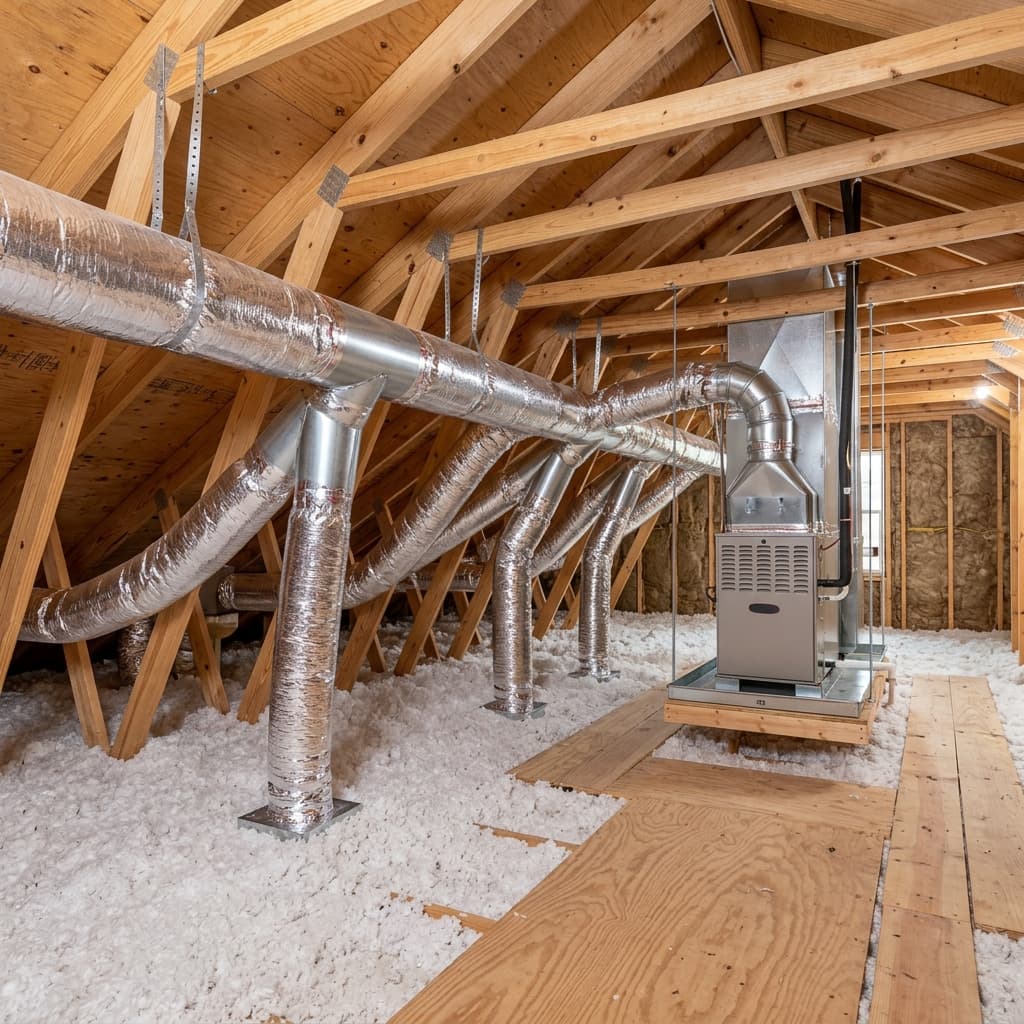
Ductwork Design (Manual D): The Unseen Key to HVAC Performance
Quick Answer: Ductwork Design (Manual D): The Unseen Key to HVAC Performance
Key Takeaways
- ACCA Manual D is the industry standard for designing a residential duct system that delivers the right amount of air to each room.
- Proper duct design is as important as proper equipment sizing (Manual J); a perfect AC unit with bad ducts will not work correctly.
- Undersized ducts create high static pressure, forcing the HVAC system to work harder, increasing energy bills and leading to premature failure.
- Oversized ducts lead to low air velocity, causing poor air mixing, stratification, and uncomfortable hot/cold spots in rooms.
- A professional HVAC contractor should perform a Manual D calculation to ensure your new system's ductwork is sized for optimal performance and comfort.
You've done your homework. You insisted on a Manual J load calculation and selected a perfectly sized, high-efficiency HVAC system. But there's a third, equally critical piece of the puzzle that is almost universally ignored by contractors: Manual D, the standard for ductwork design.
Your HVAC system is like a heart, and the ductwork is the circulatory system. If the arteries are too small or clogged, the heart has to work dangerously hard, and blood won't get where it needs to go. In the HVAC world, this leads to short-cycling, "dead zones" in your home, and an air handler motor that burns out years before its time.
What is Manual D? The Engineering Standard
Manual D is the official, industry-wide standard published by the Air Conditioning Contractors of America (ACCA) for designing and sizing a residential duct system. It is not a "rule of thumb" like the dangerous "one square inch per CFM" guess. Instead, it is a multi-step engineering process that ensures the ductwork can efficiently and quietly deliver the correct amount of conditioned air (CFM) to each room.
A proper Manual D design specifies the optimal size, shape, material, and layout for every single component of the duct system, including the supply plenum, trunk lines, take-offs, branch ducts, and the often-neglected return air system.
The Physics of Static Pressure: The "Silent Killer"
The central challenge of duct design is overcoming Static Pressure. Think of static pressure as the resistance or friction that the air encounters as it moves through the ducts, across filters, and through coils. It is measured in "inches of water column" (iwc).
Every blower motor in a furnace or air handler has a maximum pressure rating. Most residential units are designed for 0.5 iwc. If your duct system is too restrictive—due to small pipes, crushed flex-duct, or too many bends—the static pressure rises. When it hits 0.8 or 1.0 iwc, the following happens:
- Airflow Drops: Even though the fan is spinning at max speed, the physical resistance prevents the air from moving. A 3-ton AC unit might only be moving 2 tons worth of air.
- Wattage Skyrockets: Modern ECM motors will try to overcome the pressure by ramping up their speed, consuming significantly more electricity.
- Coils Freeze: In the summer, low airflow causes the evaporator coil to drop below freezing, leading to a literal block of ice in your furnace and a potential water leak when it melts.
The Secret of Total Effective Length (TEL)
One of the most profound concepts in Manual D is Equivalent Length. Friction doesn't just come from the length of the pipe; it comes from every turn, tee, and transition. In the eyes of an HVAC engineer, a 90-degree elbow isn't just a foot long—it might have the same air resistance as 30 to 50 feet of straight duct.
When designing a system, we calculate the Total Effective Length (TEL). This is the sum of the longest physical run plus the equivalent lengths of every fitting in that run. It is common for a house that is physically 40 feet long to have an effective duct length of 400 feet. If your contractor hasn't calculated the TEL, they cannot possibly size your ducts correctly.
| Duct Fitting | Equivalent Length (Approx.) | Impact on Airflow |
|---|---|---|
| Straight Metal Pipe (10') | 10 Feet | Baseline |
| Smooth 90° Elbow | 15 - 25 Feet | Moderate Resistance |
| Mitered 90° Elbow (No Vanes) | 50 - 75 Feet | High Resistance / Turbulence |
| Pinched Flex Duct Turn | 100+ Feet | Extreme Flow Restriction |
Duct Materials: Smooth Metal vs. Flexible Duct
Manual D accounts for the friction coefficient of different materials. Rigid galvanized steel is the gold standard because it is smooth and doesn't sag. Flexible duct (flex) is popular because it's cheap and fast to install, but it is an airflow disaster if not handled correctly.
If flex duct is not pulled tight, the internal wire ribs create massive turbulence. A flex duct that is only 90% extended (slightly sagged) has double the air resistance of a fully extended one. For this reason, Manual D professionals typically size flex-duct one size larger than the equivalent metal duct to account for this inherent friction.
Consequences of Ignoring Manual D
When a system is "eye-balled" instead of engineered, the homeowner pays the price for the life of the equipment. We categorize these failures into three types:
- The Noise Problem: Undersized ducts force air to move at high velocities. This creates a constant "whooshing" or whistling sound at the registers, making it difficult to sleep or hear the TV.
- The Balancing Problem: Without Manual D, the rooms closest to the furnace get blasted with air, while the master bedroom at the end of the hall gets nothing. This leads to 5-10 degree temperature differences between rooms.
- The Humidity Problem: If airflow is too low due to high static pressure, the AC coil stays too cold and can't effectively "ring out" the moisture from the air. You end up with a house that is cold but "clammy."
The #1 Cause of Early Blower Failure
Retrofitting Challenges: Can Old Ducts Handle New Units?
One of the most common mistakes in the HVAC industry occurs during "change-outs"—when a homeowner replaces an old 10 SEER AC with a new, high-efficiency 18 SEER2 unit but keeps the existing ductwork. Modern high-efficiency indoor coils are significantly larger and more restrictive than coils from 20 years ago. They require more surface area to achieve their efficiency ratings. If you place a new, "thick" coil on top of an old, undersized duct system, the static pressure will often double instantly. This is why many homeowners find that their brand-new, expensive AC unit is actually louder and less comfortable than the old one it replaced. A Manual D audit should always be part of an equipment upgrade to ensure the old "veins" can handle the new "heart."
Air Balancing: The Final Step of Manual D
Even a perfectly designed Manual D duct system requires Air Balancing after installation. This is the process of using a flow hood (balometer) to measure the actual CFM exiting each register. If a room is supposed to get 120 CFM but is only getting 90 CFM, the technician adjusts the manual volume dampers (located at the duct take-offs, not the registers) to "tune" the system. A system that hasn't been balanced is like a high-end stereo that hasn't been equalized—it might have great components, but the output won't be harmonious.
The Professional Path: Demand the Design
When getting quotes for a new HVAC system, don't just ask for the equipment price. Ask the contractor for the Manual J load calculation AND the Manual D duct design. If they tell you "we've been doing this 30 years and don't need a computer," they are telling you they intend to guess with your money, and your comfort will be the casualty.
A true professional will provide you with a report showing the target CFM for every room and the calculated static pressure of the new system. Your ductwork is the most permanent part of your HVAC system—it will likely outlast three different furnaces. Make sure it's done right the first time.
Official Sources & Resources
Frequently Asked Questions
About the Author: Jameson Miller
Jameson Miller has over 15 years of experience in the home construction and finance industries. As a lead consultant for major residential projects and a certified financial analyst, he specializes in making complex home improvement decisions simple and data-driven. His work ensures that HomeCalc Pro provides homeowners with the most accurate, industry-standard calculations available today.