

Paint Calculator Truth: Why 'Coverage' on the Can is Usually Wrong in 2026
Quick Answer: Paint Calculator Truth: Why 'Coverage' on the Can is Usually Wrong in 2026
Key Takeaways
- Paint cans claim 400 sq ft/gallon - reality is 250-350 sq ft
- New drywall needs 30% more paint than previously painted walls
- Textured walls reduce coverage by 20-30%
- Always buy one extra gallon for large projects
- Primer is non-negotiable for new drywall or dark colors
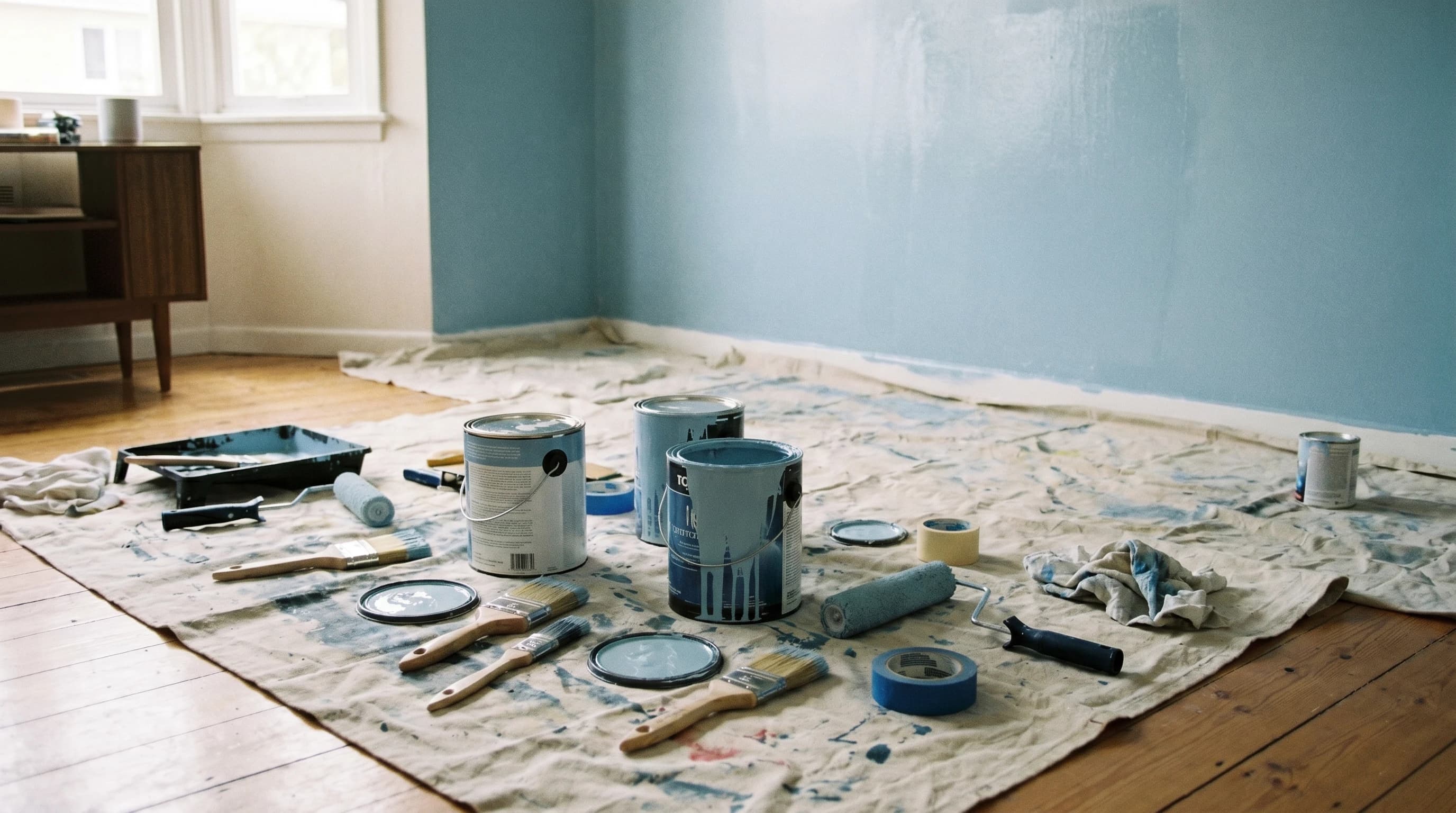
You measure the room, buy the paint, and start rolling. Halfway through the second wall, the can feels disturbingly light. By the third wall, you're shaking the last drops out. You head back to the hardware store, frustrated and $50 poorer. Why does this happen? Because the "coverage" number on the side of the paint can is a laboratory ideal, not a real-world promise.
The 400 Sq. Ft. Myth: Laboratory vs. Reality
Every paint can label from every major manufacturer claims the same thing: "Covers up to 400 square feet per gallon." Note the two most important words in that sentence: "up to." This number is not a real-world promise; it is a laboratory measurement derived from testing the paint on a perfectly sealed, non-porous, perfectly smooth piece of plastic at a precise thickness of exactly 4 "mils" (one-thousandth of an inch) wet.
In the real world, your walls are not smooth plastic. They are thirsty sponges made of gypsum and paper. They have texture. They have previous layers of paint with varying levels of gloss. They have patches of joint compound that absorb moisture at different rates. In reality, you should expect 300 to 350 square feet of coverage per gallon for high-quality paint on a standard repaint, and as little as 200 to 250 square feet if you are painting bare drywall or heavy texture.
Standard Coverage by Surface Type
| Surface Type | Est. Coverage (Sq Ft / Gal) |
|---|---|
| Sealed/Smooth Drywall | 350 - 400 |
| Light Texture (Orange Peel) | 300 - 350 |
| Heavy Texture (Knockdown) | 250 - 300 |
| Unprimed Drywall | 200 - 250 |
| Brick or Cinder Block | 150 - 200 |
The Science of Opacity: Pigment vs. Binder vs. Solvent
Paint is made of three things:
- Solvent (Water/Oil): The vehicle that carries the paint to the wall. It evaporates 100%.
- Pigment: The color particles (Titanium Dioxide is the main white pigment).
- Binder (Resin): The glue that holds the pigment to the wall.
Cheap paint is 70% solvent (water). When you roll it on, it looks thick. But as the water evaporates, the film shrinks drastically. You are left with a thin, weak layer of pigment that doesn't hide the color underneath.
Premium paint has less solvent and more Titanium Dioxide and high-quality acrylic resins. When it dries, it leaves a thicker, tougher film that hides better.
Volume Solids: The Real Metric
When buying paint, look at the Technical Data Sheet (TDS) for "Volume Solids."
- Economy Paint: 25-30% Volume Solids. (Watery, poor hiding).
- Mid-Grade Paint: 35-40% Volume Solids. (Standard).
- Premium Paint: 45%+ Volume Solids. (Thick, one-coat potential).
Factor 1: Surface Porosity
Unprimed drywall is a sponge. It will suck the binder right out of your paint, leaving a dull, blotchy finish. This is called "flashing."
If you are painting new drywall, or a "builder flat" paint, calculate for 30-40% less coverage on the first coat unless you use a dedicated PVA Primer/Sealer.
Factor 2: Surface Texture and "Hidden" Square Footage
Texture is the silent killer of paint coverage. When you calculate the square footage of your room by multiplying the length times the height, you are measuring the "planimetric" area—the flat 2D surface. However, a wall with texture has much more physical surface area than a smooth wall because of the "peaks and valleys" of the texture.
- Smooth Wall: No multiplier. Your calculation is accurate.
- Orange Peel Texture: Adds approximately 15% to the physical surface area. A 1,000 sq ft room actually has 1,150 sq ft of surface to be coated.
- Knockdown Texture: Adds approximately 25-30% to the surface area.
- Popcorn Ceilings: These are the most extreme, adding up to 50% more surface area. Painting a popcorn ceiling with a roller is notoriously difficult and uses a massive amount of paint because the material is both highly porous and highly textured.
When using our Paint Calculator, we recommend adding a 20% "Texture Factor" if your walls are anything other than perfectly smooth. This ensures you buy enough paint for both coats without having to stop mid-project.
How Paint Sheen Affects Your Coverage
The "gloss" level of your paint also impacts how much you need. Higher sheens (like Semi-Gloss or High-Gloss) have more resins and binders, which naturally create a thinner, more durable film. Lower sheens (like Flat or Matte) have more pigments and "fillers," which result in a thicker, less durable film.
- Flat / Matte: These have the highest pigment-to-binder ratio. They are excellent at hiding imperfections but are the most "absorbent" sheens. Expect slightly lower coverage (approx. 325 sq ft/gal).
- Eggshell / Satin: The "Goldilocks" of paint sheens. They offer a good balance of durability and coverage. This is where most manufacturers get their 400 sq ft/gal rating.
- Semi-Gloss / High-Gloss: These sheens are very "slick." While they technically cover a lot of area, they show every single lap mark and brush stroke. To get a professional, uniform finish with high-gloss paint, you often need three thin coats rather than two thick ones, effectively doubling your material needs.
The Primer Advantage
Primer is cheaper than paint. Use IT.
- PVA Primer ($15/gal): Seals new drywall. Mandatory.
- High-Hiding Primer ($25/gal): Tintable grey. Mandatory for covering dark red/blue walls with white.
- Bonding Primer ($50/gal): Sticks to glossy surfaces, glass, tile.
Tools Matter: Don't Use a cheap Roller
The applicator determines the film thickness.
- 3/8" Nap: Standard for smooth walls.
- 1/2" Nap: Best for most repaints and light texture. Holds more paint, speeds up the job.
- 3/4" - 1" Nap: Required for stucco, brick, or heavy popcorn.
Warning: Cheap "bargain bin" roller covers shed tint fibers into your paint wall. Spend the extra $3 for a shed-resistant woven cover (like Purdy White Dove or Wooster Pro).
The Spray Gun Mistake
If you rent a sprayer, assume a **30% loss** due to overspray (paint turning into mist and floating away). A sprayer is fast, but it wastes material. Buy extra paint.
The Hidden Costs of Color Choice: Dark vs. Light
Did you know that the color you choose impacts your coverage as much as the quality of the paint? This is due to the Pigment Load and the type of base used by the paint store.
- Light Colors: These typically use a "White Base" which is heavy in Titanium Dioxide. They hide existing colors very well and usually achieve full opacity in two coats.
- Dark/Vibrant Colors: Deep reds, navy blues, and forest greens often use a "Deep Base" or "Clear Base." These bases have very little white pigment, meaning they are naturally more translucent. To get an even, rich color with a deep red, you may need four or even five coats unless you use a specialized grey-tinted primer first.
Paint Coverage by Room Type: What to Expect
Different rooms in your house present different challenges for paint yield:
- Kitchens: Cooking grease and smoke create a film on walls that prevents paint from sticking and spreading evenly. Always wash kitchen walls with TSP (Trisodium Phosphate) before painting to ensure you get the maximum coverage.
- Bathrooms: High humidity often leads to "surfactant leaching"—where the ingredients of the paint rise to the surface in sticky streaks. Use a specialized "Kitchen & Bath" paint which is formulated to resist moisture, even though these paints are often thicker and cover slightly less area (approx 300 sq ft/gal).
- Garages: Most garage walls are "Level 2" drywall finish (just one coat of tape and mud). This is the most porous surface in a home. Expect to use 50% more paint for a garage than you would for a finished bedroom.
Calculating Your Real Needs: The Professional Formula
To ensure you never run out of paint, forget the optimistic 400 sq. ft. number on the can. Professionals use a more conservative baseline of 350 square feet per gallon for the first coat and 400 square feet for the second coat (since the first coat seals the wall). Use this step-by-step formula for a successful project:
Net Sq. Ft. / 350 = Gallons Per Coat
Gallons Per Coat x 2 = Total Gallons Needed
Example: A 12x12 room (48 ft perimeter) with 8ft ceilings has 384 sq. ft. of wall. Subtract 20 sq. ft. for a door/window = 364 sq. ft.
364 / 350 = 1.04 gallons. You need just over 1 gallon per coat. For 2 coats, you need 2.08 gallons.
You must buy 3 gallons. Or 2 gallons and a quart (if available).
Professional Tips for Maximum Paint Yield
While buying the right amount of paint is the first step, how you apply it determines how far that paint actually goes. Here are three professional secrets for maximizing your coverage:
- The "Loaded" Roller: Many DIYers try to "stretch" the paint by pressing hard on the roller when it is almost dry. This results in a thin, uneven film that will require a third coat. Keep your roller "loaded" with paint and let the tool do the work. If you hear a "tearing" or "velcro" sound while rolling, your roller is too dry.
- Maintain a "Wet Edge": Always work from a dry area back into the wet paint you just applied. This prevents "lapping"—those ugly dark stripes where two semi-dry layers of paint overlap. Maintaining a wet edge ensures the entire wall dries as one cohesive film, which improves the apparent "hide" of the paint.
- Temperature Control: Never paint in a room that is too hot (above 85°F) or too cold (below 55°F). If it is too hot, the solvent evaporates too quickly, causing the paint to "drag" and reducing your coverage. If it is too cold, the paint won't flow out correctly, leading to thick, wasteful applications.
Final Thoughts: The Cost of a Mid-Project Run
The "Truth about Paint Coverage" is that it is always safer to have a half-gallon left over than to be a half-gallon short. When you run out of paint, the cost isn't just the $60 for a new can; it's the two hours of lost time, the gas to the store, and the high risk that the new can won't be a 100% perfect match to the first one.
By using our Paint Calculator and applying a realistic 350 sq. ft. coverage factor, you can approach your next painting project with the confidence of a professional contractor. Remember: buy high-quality paint, use high-quality tools, and always buy 10% more than you think you need.
Conclusion: Master Your Project budget
Understanding the truth about paint coverage is the difference between a stressful DIY weekend and a smooth, successful home transformation. Don't let laboratory numbers on a can dictate your project's timeline or budget. Armed with the knowledge of porosity, texture, and volume solids, you are now equipped to calculate your needs with actuarial precision.
Sources
Frequently Asked Questions
About the Author: Jameson Miller
Jameson Miller has over 15 years of experience in the home construction and finance industries. As a lead consultant for major residential projects and a certified financial analyst, he specializes in making complex home improvement decisions simple and data-driven. His work ensures that HomeCalc Pro provides homeowners with the most accurate, industry-standard calculations available today.