

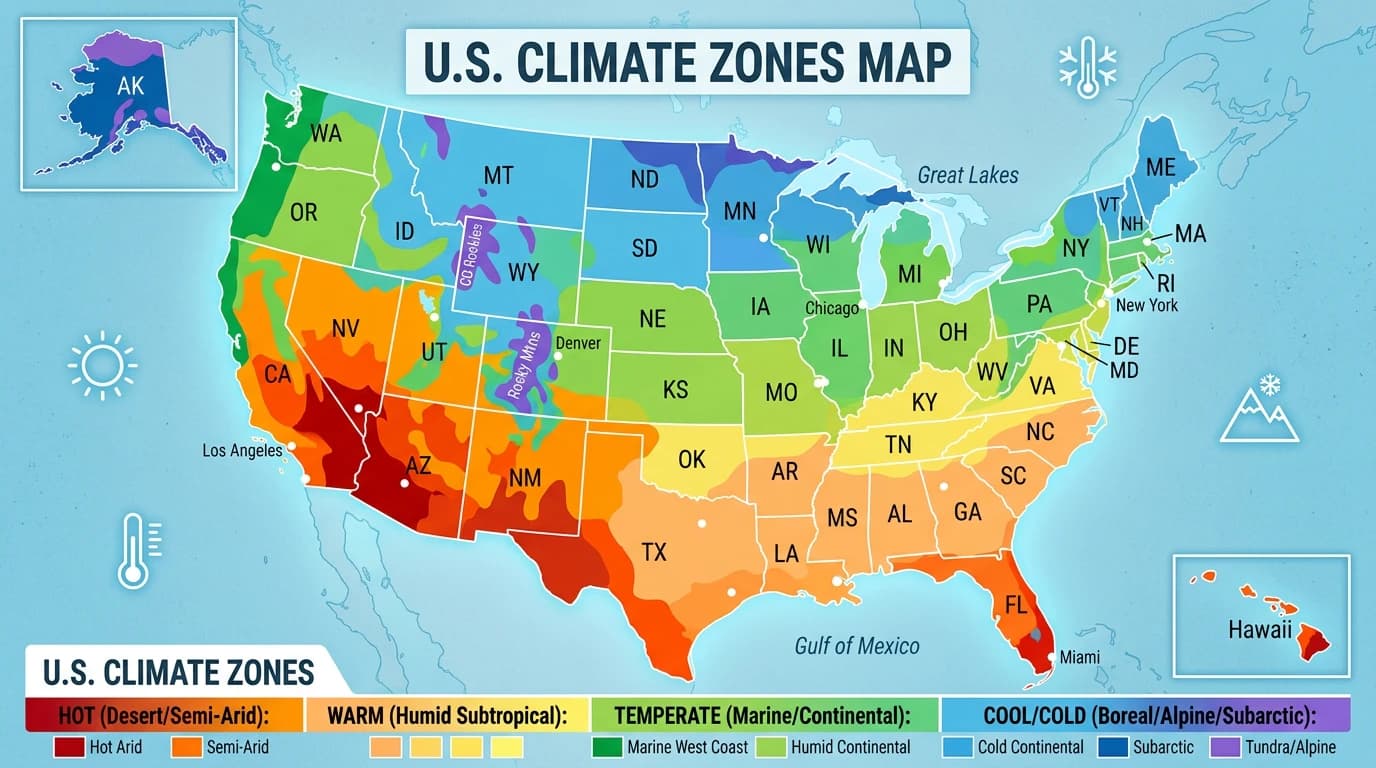
Climate Zones 101: Why Your Location Dictates Your HVAC Size (2026 DOE Zones)
Quick Answer: Climate Zones 101: Why Your Location Dictates Your HVAC Size (2026 DOE Zones)
Key Takeaways
- The U.S. is divided into 7 DOE Climate Zones that classify regions based on heating and cooling needs.
- Your zone dictates two critical factors: the minimum required insulation R-Value and the specific load factor used in your HVAC sizing (Manual J).
- Zones in the South (like Zone 2) prioritize cooling and dehumidification, requiring smaller AC units to run longer.
- Zones in the North (like Zone 6) prioritize heating, requiring much higher insulation R-Values in the attic and walls.
- Choosing the wrong HVAC size for your zone results in wasted energy, poor humidity control, and a shorter equipment lifespan.
When sizing a new HVAC system, neglecting the specific climate of your location is the biggest mistake a homeowner or contractor can make.' Why does a 2,500 square foot home in Phoenix, Arizona, need a much larger air conditioner than a comparable home in Seattle, Washington? The answer lies in one foundational concept: DOE Climate Zones.
The climate you live in—specifically, the average high/low temperatures, humidity levels, and solar intensity—must be the primary driver of your system's design. The DOE and IECC have classified the entire country into 8 distinct Climate Zones, which serve as the regulatory basis for all building codes. Knowing your specific zone is the first and most critical step in ensuring your home is insulated, air-sealed, and heated/cooled correctly.
Defining the IECC Zones: The Science of Degree Days
A Climate Zone is a geographically defined area that shares similar long-term weather patterns and extreme design temperatures. The Department of Energy uses two primary metrics to categorize these zones:
- Heating Degree Days (HDD): A cumulative measure of how much and for how long the outdoor temperature stays below 65°F. The more HDD, the colder the climate and the more robust your heating system needs to be.
- Cooling Degree Days (CDD): A measure of how much and for how long the outdoor temperature stays above 65°F. High CDD values correlate to tropical or desert regions where cooling is the primary energy expense.
The zones range from Zone 1 (Tropical, like Miami and Hawaii) to Zone 8 (Sub-arctic, like Northern Alaska). Most of the continental United States falls between Zone 2 and Zone 6.
Moisture Regimes: The A, B, and C Sub-zones
Many homeowners don't realize that the number (1-8) is only half the story. The IECC also assigns a letter to represent the "Moisture Regime." This is arguably more important for HVAC sizing than the temperature itself.
- A (Moist): High humidity. Found in the Eastern and Central US. In these areas, your AC must be sized to remove massive amounts of water vapor (Latent Load).
- B (Dry): Arid or semi-arid. Found in the Mountain West and Southwest. Humidity is low, meaning the AC can focus almost entirely on lowering the temperature (Sensible Load).
- C (Marine): Cool and damp, but not extreme. Found along the Pacific Coast. These regions require constant, low-level heating and moisture management to prevent mold.
Example: A home in Zone 4A (Baltimore, MD) needs a very different HVAC setup than a home in Zone 4B (Albuquerque, NM), despite sharing similar average temperatures.
| Climate Zone | Representative Cities | Attic R-Value (Min) | Window U-Factor |
|---|---|---|---|
| Zone 1 | Hot, Humid (e.g., Miami, Keys) | R-38 | 0.50 |
| Zone 2 | Hot, Humid (e.g., Houston, Orlando) | R-38 to R-49 | 0.40 |
| Zone 3 | Warm/Moderate (e.g., Atlanta, Dallas) | R-49 | 0.30 |
| Zone 4 | Mixed, Cold Winter (e.g., NYC, Seattle) | R-49 to R-60 | 0.30 |
| Zone 5 | Cold (e.g., Chicago, Denver) | R-60 | 0.30 |
| Zone 6 | Very Cold (e.g., Minneapolis, Duluth) | R-60+ | 0.27 |
| Zone 7-8 | Arctic (e.g., Alaska, N. Dakota) | R-60+ | 0.25 |
How Zones Dictate Your Insulation (R-Values)
The IECC sets mandatory minimum R-values based on your zone. The R-value measures the resistance to heat flow. The greater the temperature difference between inside and outside, the more R-value you need.
In Zone 2 (The South), the difference between a 75°F living room and a 95°F afternoon is only 20 degrees. R-38 insulation is often sufficient. However, in Zone 6 (The North), the difference between a 70°F living room and a -20°F winter night is a staggering 90 degrees. This is why building codes in the North now mandate R-60 in the attic. If you use "Southern" insulation in a "Northern" climate, your heating bills will be 300% higher than they should be.
Manual J and Design Temperatures
When an engineer performs a Manual J Load Calculation, the first thing they look up is the "Design Temperature" for your specific zone. This is NOT the record high or low. It is the temperature that is exceeded only 1% of the time.
For example, the design temperature for Chicago (Zone 5) is 91°F. This means the AC is sized to keep the house cool when it's 91°F outside. If it hits 100°F once every five years, the house might warm up to 74°F or 75°F. This is intentional. If you size for the absolute record high, the unit will be grossly oversized for the other 99% of the summer, leading to poor dehumidification and short-cycling.
Fenestration: Windows and Solar Heat Gain
Windows (fenestration) are the weakest link in your home's thermal envelope. Climate zones dictate two numbers for windows:
- U-Factor: How well the window prevents heat from escaping. Lower is better. In the North, this is the most important number.
- SHGC (Solar Heat Gain Coefficient): How much heat from the sun passes through the glass. In the South (Zone 1-2), you want a very low SHGC to keep the sun from "baking" your home. In the North, you might actually want a slightly higher SHGC on south-facing windows to help heat your home for free in the winter.
The Heat Pump Revolution: Cold Climate Technology
The biggest change in climate-zone-specific engineering is the rise of Cold Climate Heat Pumps (CCHP). Traditionally, heat pumps were only recommended for Zones 1-4. Once it dropped below 30°F, they lost efficiency and needed expensive "backup" electric heat. Modern CCHPs are specifically engineered for Zones 5-7. They use variable-speed inverter compressors to extract heat from air that is as cold as -15°F. If you live in the North and are considering a heat pump, you must verify it is rated for your specific climate zone.
Avoid the "One Size Fits All" Trap
The High Cost of Ignorance
Ignoring your climate zone is the fastest way to waste money. An HVAC system that is perfect for Florida will fail miserably in Maine, and vice versa. Whether you are adding attic insulation or sizing a new furnace, the climate zone map is your most important tool.
Don't let a contractor guess. Use our professional-grade calculators to see exactly how your location impacts your home's requirements before you sign a contract.
Sources
Frequently Asked Questions
About the Author: Jameson Miller
Jameson Miller has over 15 years of experience in the home construction and finance industries. As a lead consultant for major residential projects and a certified financial analyst, he specializes in making complex home improvement decisions simple and data-driven. His work ensures that HomeCalc Pro provides homeowners with the most accurate, industry-standard calculations available today.