

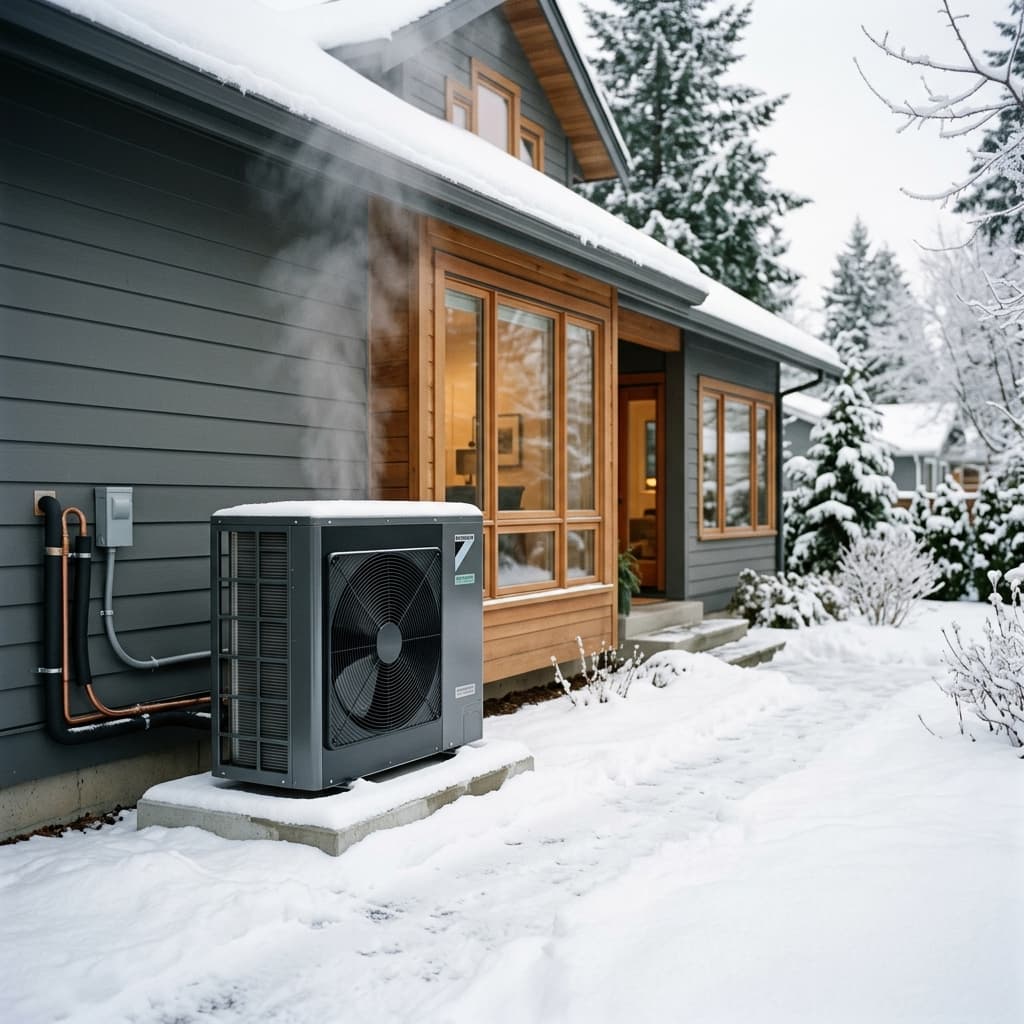
Heat Pump vs. Gas Furnace: Which is Right for Your Climate Zone in 2026?
Quick Answer: Heat Pump vs. Gas Furnace: Which is Right for Your Climate Zone in 2026?
Key Takeaways
- Heat pumps are highly efficient at both heating and cooling, making them ideal for moderate climates (Zones 1-4).
- Gas furnaces provide powerful, consistent heat and are often the most reliable and cost-effective choice in very cold climates (Zones 5-7).
- A modern cold-climate heat pump can operate efficiently down to about 5°F (-15°C), but its output diminishes as temperatures drop further.
- A 'dual fuel' system combines a heat pump with a gas furnace, using the most efficient fuel source for the current outdoor temperature.
- The best choice depends on your local utility costs (gas vs. electricity) and your climate zone's heating demands.
Choosing a new heating system is a major decision with long-term financial implications. The two most dominant options on the market today are the traditional gas furnace and the increasingly popular electric heat pump. While both can effectively heat a home, they work on fundamentally different principles and excel in different environments.
The right choice for your home depends almost entirely on two factors: your local climate and your utility costs.
Choosing a new heating system is a major decision with long-term financial and comfort implications. The two most dominant options on the market today are the traditional gas furnace and the increasingly popular electric air-source heat pump. While both can effectively heat a home, they work on fundamentally different physical principles and excel in very different environments. This guide explores the engineering, economics, and practical reality of both systems to help you make an informed investment for your specific home.
How They Work: The Physics of Creating vs. Moving Heat
The fundamental technical difference between these two systems is their method of thermal energy management. Understanding this is key to grasping why their efficiencies differ so drastically.
- The Gas Furnace (Heat Creator): A furnace uses combustion. When the thermostat calls for heat, a valve opens to allow natural gas or propane into a burner, where it is ignited. The resulting flames heat a metal component called a heat exchanger. A blower fan then forces return air from your home across the outside of this exchanger, where it picks up heat before being distributed through your ducts. The combustion byproducts (exhaust) are vented safely outside.
- The Heat Pump (Heat Mover): A heat pump uses the principles of refrigeration. It consists of an indoor coil, an outdoor coil, and a compressor. In the winter, it circulates a specialized refrigerant that is much colder than the outdoor air. This allows it to absorb thermal energy from the outside (even in freezing temps). The compressor then squeezes this refrigerant, raising its temperature significantly. This hot refrigerant is pumped to the indoor coil, where the blower fan moves house air across it to pick up the heat. In the summer, the process is simply reversed to provide cooling.
Because the heat pump is moving existing heat rather than creating it through fire, it can achieve efficiencies that seem mathematically impossible. While a high-efficiency gas furnace can reach 98% AFUE (meaning 2% of the fuel energy is lost), a modern heat pump can achieve a Coefficient of Performance (COP) of 3.0 to 4.0. This means that for every 1 unit of electricity you pay for, you get 3 to 4 units of actual heat delivered into your home.
| Feature | Heat Pump | Gas Furnace |
|---|---|---|
| Primary Function | Heats and Cools (All-in-one) | Heats Only (Requires separate AC) |
| Energy Source | Electricity (moves heat) | Natural Gas, Propane, or Oil (creates heat) |
| Efficiency | Extremely high (200-400%+) in moderate temps | High (80-98%) but always <100% |
| Cold Weather Performance | Loses efficiency below freezing; needs backup | Excellent, consistent heat at any temp |
| Upfront Cost | Higher | Lower (for furnace alone) |
The Deciding Factor: How Geography Dictates Efficiency
The single most important variable in this decision is your DOE Climate Zone. Because air-source heat pumps rely on the ambient temperature, their performance is geographically sensitive. In contrast, a gas furnace burns fuel at the same temperature regardless of whether it's 40°F or -40°F outside.
Heating in Zones 1-3 (The Sun Belt and Deep South)
In these regions, where winter temperatures rarely dip below freezing for extended periods, the heat pump is the undisputed champion. A heat pump in Atlanta or Phoenix will spend the vast majority of its time operating at its highest efficiency levels. Because these homes also require significant cooling in the summer, the all-in-one nature of the heat pump provides a lower total system cost than installing both a furnace and a high-end AC unit.
Heating in Zones 4-5 (The Mid-Atlantic and Midwest)
This is where the decision becomes more nuanced. In places like Columbus or St. Louis, we experience "shoulder seasons" where a heat pump is ideal, but also "polar vortex" events where the temperature can plummet. Traditional heat pumps struggle in these extremes, but Cold Climate Heat Pumps (CCHP) have changed the game. These units use advanced vapor-injection technology to maintain their heating capacity down to 0°F and even -15°F. For these zones, a CCHP is often the best long-term investment, though it carries a higher upfront price tag.
Heating in Zones 6-7 (The North and Mountain Regions)
In the coldest parts of the country, such as Minneapolis or Maine, a high-efficiency gas furnace is usually the most reliable primary heat source. While a cold-climate heat pump *can* work there, the amount of energy required to extract heat from -20°F air is significant. Furthermore, if the power goes out during a blizzard, a gas furnace can often be run off a small portable generator, whereas a whole-home electric heat pump requires a massive power source that most residential backup systems cannot provide.
The Economic Analysis: Upfront Investment vs. Lifetime savings
When analyzing the cost, you must look at the Total Cost of Ownership (TCO) over a 15-year horizon, not just the check you write to the contractor on installation day.
1. Initial Installation Cost: A standard air-source heat pump typically costs between $6,000 and $12,000 to install. A gas furnace alone costs $3,000 to $6,000. However, if you also need to replace your air conditioner, the total for a furnace + AC combo is often $8,000 to $15,000. This makes the heat pump roughly comparable to a full system replacement.
2. Incentives and Tax Credits: Thanks to the 2022 Inflation Reduction Act, the federal government offers a 25C Tax Credit of up to $2,000 specifically for high-efficiency heat pumps. Gas furnaces are capped at a much lower $600 credit. When you factor in local utility rebates, the net cost of a heat pump can often be lower than a traditional gas system.
3. Monthly Energy Bills: This is the most variable factor. You must calculate the cost per unit of heat (MMBtu) for each fuel. As a general rule, if your electricity is under $0.14 per kWh and natural gas is over $1.50 per therm, a heat pump will save you money every single month. Our Heat Pump Cost Estimator can help you run these numbers for your specific local rates.
Maintenance and Longevity: What to Expect
Reliability is a key factor for any homeowner. Because a gas furnace only runs for about 5 months of the year, its internal components (burners, igniters, inducer motors) experience less wear and tear. A well-maintained furnace can easily last 20 years.
A heat pump, however, is a "dual-use" machine. It handles both heating and cooling, meaning it runs for 10 to 12 months of the year. This increased usage typically leads to a shorter lifespan, usually 12 to 15 years. Furthermore, heat pumps require more technical maintenance; the outdoor coil must be kept clear of snow and ice in the winter, and the refrigerant charge must be precise for the system to heat effectively. We recommend a bi-annual professional tune-up for any heat pump system.
The Ultimate Solution: The Dual-Fuel (Hybrid) System
For homeowners in cold climates (Zone 4 and 5) WHO want the best of both worlds, a dual-fuel system is the ultimate solution. This system pairs an electric heat pump with a gas furnace.
- During milder weather (e.g., above 35°F), the highly efficient heat pump handles all heating and cooling.
- When the temperature drops below a pre-set 'switchover' point, the heat pump turns off and the powerful gas furnace takes over.
This ensures you are always using the most cost-effective fuel source for the current conditions, maximizing both efficiency and comfort.
Comfort Factors: Air Temperature and Dehumidification
Beyond the cost, there is the issue of "how the heat feels." This is a subjective but important consideration for many families.
- Gas Furnace Comfort: A gas furnace produces "hot" air. The air coming out of your vents is typically between 120°F and 140°F. This provides a satisfying blast of warmth that can heat up a cold house very quickly. However, this high temperature can also lead to lower indoor humidity, making the air feel "dry" and causing static electricity.
- Heat Pump Comfort: A heat pump produces "warm" air. The supply air temperature is usually between 90°F and 105°F. While this is plenty warm enough to heat your home to 70°F, it can feel "cool" if the air blows directly on your skin. Modern variable-speed heat pumps mitigate this by running for longer cycles at lower speeds, providing a more consistent and even temperature throughout the home without the "hot-cold" swings of a standard furnace.
Making the Final Choice: Which is Right for Your Home?
There is no single 'best' answer for every house. The right choice is a practical engineering decision based on your specific geography, local infrastructure, and financial goals.
- Choose a Heat Pump if: You live in Climate Zones 1-4, you have solar panels, you want to reduce your carbon footprint, or you currently rely on expensive propane or electric baseboard heat.
- Choose a Gas Furnace if: You live in Climate Zones 6-7, you have access to very cheap natural gas, or you prefer the "blast of heat" feeling from your registers.
- Choose a Dual-Fuel System if: You live in a mixed climate (Zone 4 or 5), you want the ultimate in comfort and efficiency, and you have the budget for a slightly higher upfront investment.
Before you commit to a multi-thousand dollar installation, we highly recommend using our suite of professional HVAC tools to establish your baseline needs. Don't let a contractor talk you into an oversized system or the wrong technology without doing your own data-driven research first.
Official Sources & Resources
Frequently Asked Questions
About the Author: Jameson Miller
Jameson Miller has over 15 years of experience in the home construction and finance industries. As a lead consultant for major residential projects and a certified financial analyst, he specializes in making complex home improvement decisions simple and data-driven. His work ensures that HomeCalc Pro provides homeowners with the most accurate, industry-standard calculations available today.