

What is AFUE? Understanding Furnace Efficiency Ratings
Quick Answer: What is AFUE? Understanding Furnace Efficiency Ratings
Key Takeaways
- AFUE measures how much fuel a furnace converts into usable heat; a 95% AFUE furnace converts 95 cents of every dollar into heat, wasting only 5 cents.
- The main difference is venting: 80% furnaces use a metal flue, while high-efficiency (90%+) furnaces use PVC pipes and create condensate.
- Upgrading from an 80% to a 95% AFUE furnace can reduce heating costs by 15-20%, but has a higher upfront cost.
- The financial benefit of a high-efficiency furnace is greatest in colder climates (Zones 4-7) where heating runs frequently.
- Federal tax credits and local utility rebates can significantly reduce the net cost of upgrading to a high-efficiency furnace.
When shopping for a new gas furnace, you will inevitably encounter the term AFUE. It is the single most important number on the EnergyGuide label, yet many homeowners don't fully understand how it impacts their long-term finances or the technical requirements of their home. This guide provides a professional engineering perspective on AFUE, explaining why it matters and how to choose the right rating for your specific climate.
The Engineering Behind AFUE: What the Percentage Really Means
AFUE stands for Annual Fuel Utilization Efficiency. It is a measure of a furnace's seasonal thermal efficiency. Unlike a simple steady-state efficiency test, AFUE accounts for the typical "on-off" cycling of a furnace throughout a standard heating season.
Mathematically, AFUE is the ratio of annual heat output of the furnace compared to the total annual fossil fuel energy consumed by the furnace. For example, if a furnace has a 96% AFUE rating, it means that 96% of the energy in the fuel is converted into delivered heat for your home. The remaining 4% is "waste energy"—thermal energy that escapes through the venting system as hot exhaust gases.
To put this in financial terms: for every $100 you spend on natural gas or propane, a 96% efficient furnace provides $96 worth of actual warmth, while $4 is essentially discarded. In contrast, an older 70% AFUE furnace (common in homes built before 1990) would discard $30 of every $100 spent.
The Technical Divide: Standard (80%) vs. High-Efficiency (90%+)
In the modern HVAC market, furnaces are bifurcated into two distinct technological categories based on their AFUE rating. This is not just a difference in "quality," but a fundamental difference in how the machine handles combustion and exhaust.
Standard Efficiency (80% AFUE)
These units utilize a single heat exchanger, usually made of aluminized steel. The combustion gases pass through the exchanger, heat is transferred to the house air, and the exhaust exits the furnace at a very high temperature (often exceeding 400°F). Because the exhaust is so hot, it creates a natural draft, allowing it to rise safely through a vertical metal flue or a masonry chimney. These units are simpler, have fewer components to fail, and have a lower initial purchase price.
High-Efficiency "Condensing" Furnaces (90% to 98.5% AFUE)
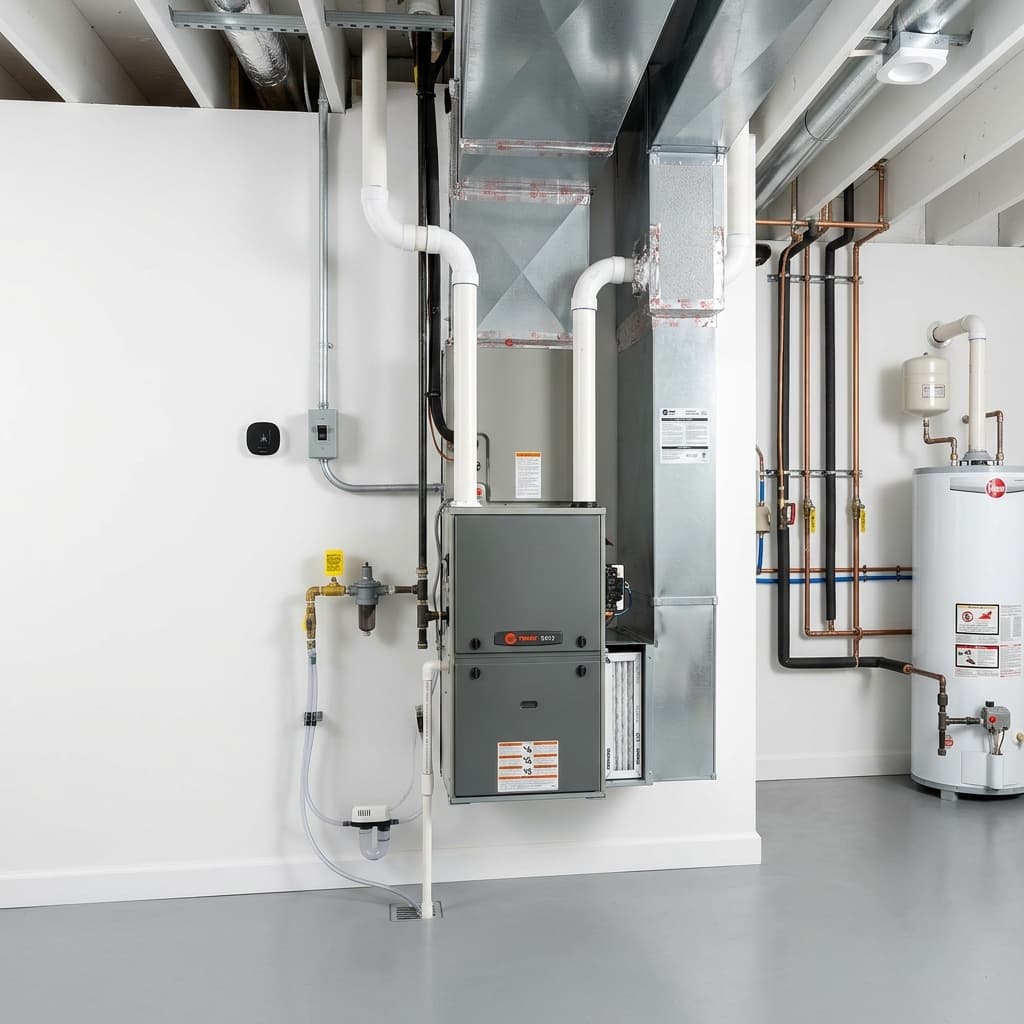
To reach efficiencies above 90%, engineers add a secondary heat exchanger, typically made of high-grade stainless steel to resist corrosion. This second exchanger extracts so much heat from the exhaust that the gases actually cool down to the point of "condensing"—turning from a gas into a liquid (water). Because the exhaust is now cool (usually around 100°F), it no longer has a natural draft and cannot be vented through a traditional chimney. Instead, a powerful inducer motor pushes the cool exhaust out of the house through airtight PVC pipes. Furthermore, because these units produce water, they require a dedicated drain line or a condensate pump.
| Feature | 80% AFUE (Non-Condensing) | 95%+ AFUE (Condensing) |
|---|---|---|
| Venting Material | B-Vent Metal or Masonry | PVC (Schedule 40) |
| Heat Exchangers | Single | Primary + Secondary |
| Condensate Drain | Not Required | Required (Produces Acidic Water) |
| Avg. Lifespan | 18-25 Years | 15-20 Years |
Venting and Installation Requirements
When upgrading your AFUE rating, you must account for the change in infrastructure. This is often the most overlooked cost of a high-efficiency upgrade.
- The PVC Shift: Because 90%+ furnaces have cool exhaust, they cannot use your old metal chimney. They require two PVC pipes (one for intake air, one for exhaust) to be routed through the side of your home. If your furnace is in the center of the basement, this can involve significant labor and structural drilling.
- Condensate Management: High-efficiency furnaces can produce up to 5 gallons of water per day. This water is slightly acidic and must be piped to a floor drain or a neutralizer box. If your furnace is in an attic or a crawlspace where freezing is a risk, this drain line must be heat-taped or properly insulated to prevent ice blockages that will shut down your furnace.
- Combustion Air: Standard 80% furnaces often use "ambient air" from the room they are in. High-efficiency units are typically "sealed combustion," meaning they pull fresh air directly from outside. This is safer and prevents the furnace from sucking cold air into your home through cracks in the walls.
The ROI Analysis: Is a High AFUE Worth the Extra Investment?
A high-efficiency furnace can cost anywhere from $1,000 to $2,500 more than a standard unit, depending on the brand and installation complexity. Whether this "efficiency premium" is a good investment depends on three critical factors:
1. Your Climate Zone: If you live in DOE Climate Zones 5, 6, or 7 (The North, Midwest, and Mountain regions), your furnace will run for thousands of hours per year. In these regions, the 15% fuel savings of a high-efficiency unit will often pay for itself in 5 to 7 years. Conversely, if you live in Florida or Texas (Zones 1-2), you may only run your furnace for 200 hours a year, meaning the payback period could exceed 20 years—longer than the lifespan of the furnace itself.
2. Local Fuel Infrastructure: If your home uses Propane (LPG) or Heating Oil, which are significantly more expensive than natural gas, every point of AFUE becomes much more valuable. High fuel costs drastically shorten the payback period of a high-efficiency investment.
3. Installation Complexity: Upgrading from an 80% to a 95% unit isn't always a "drop-in" replacement. You may need to run new PVC venting through a finished basement wall or install a condensate pump if there isn't a floor drain nearby. These "hidden" installation costs can sometimes eat into your projected energy savings.
Beyond AFUE: Other Features That Save Money
While AFUE measures fuel efficiency, it doesn't tell the whole story of comfort and total energy cost. To maximize your investment, you should also look for these two features:
- Variable-Speed Blower Motors (ECM): While AFUE tracks gas usage, a variable-speed motor tracks electricity usage. These motors can run at very low speeds to provide gentle, quiet circulation, using up to 75% less electricity than a standard fixed-speed motor.
- Modulating Gas Valves: A standard furnace is either "on" (100% fire) or "off." A modulating furnace can adjust its flame height in tiny increments (e.g., 40% to 100%) to perfectly match the heat loss of your home. This prevents the "hot-cold" swings and ensures the furnace runs for longer, more efficient cycles.
Critical: Sizing Matters More Than Efficiency
Federal Incentives: The IRA and Tax Credits
If you are considering a 95% AFUE or higher furnace, the federal government has made the decision significantly easier. Under the Inflation Reduction Act (IRA), the 25C tax credit provides up to $600 per year for high-efficiency gas furnaces that meet the ENERGY STAR "Most Efficient" criteria. Additionally, many states are launching the HEERHA rebate programs, which could provide up to $1,600 in point-of-sale discounts for high-efficiency heating upgrades for low-to-moderate income households. When you combine these tax credits with the $200-$400 in annual fuel savings, the "premium" price of a high-efficiency furnace can often be recovered in as little as 2 to 3 years.
Impact on Home Resale Value
A furnace is a "major system" in a home inspection report. When selling your home, having a 96% AFUE condensing furnace with a transferable warranty is a significant selling point. Prospective buyers, especially those looking at older homes, are often wary of high utility bills. Being able to provide a years' worth of low heating bills and showing a modern, high-efficiency mechanical room adds tangible value and trust to the transaction. It signals to the buyer that the home has been well-maintained and engineered for the future.
The Professional Verdict
As a general rule of thumb for 2026:
- In the North (Zones 4-7): Never install anything less than a 95% AFUE furnace. The energy savings and current federal tax incentives make it the clear financial winner.
- In the South (Zones 1-3): An 80% AFUE furnace is often the most logical choice, provided it is paired with a high-efficiency blower motor and a high-SEER air conditioner.
- For Rental Properties: If the tenant pays the utilities, an 80% unit is often chosen for its lower upfront cost and long-term durability. If the landlord pays the utilities, a 95%+ unit is essential to protect the bottom line.
Before making a purchase, we recommend using our Furnace Cost Calculator to run a side-by-side comparison of different AFUE ratings based on your actual local gas prices and climate data.
Official Sources & Resources
Frequently Asked Questions
About the Author: Jameson Miller
Jameson Miller has over 15 years of experience in the home construction and finance industries. As a lead consultant for major residential projects and a certified financial analyst, he specializes in making complex home improvement decisions simple and data-driven. His work ensures that HomeCalc Pro provides homeowners with the most accurate, industry-standard calculations available today.