

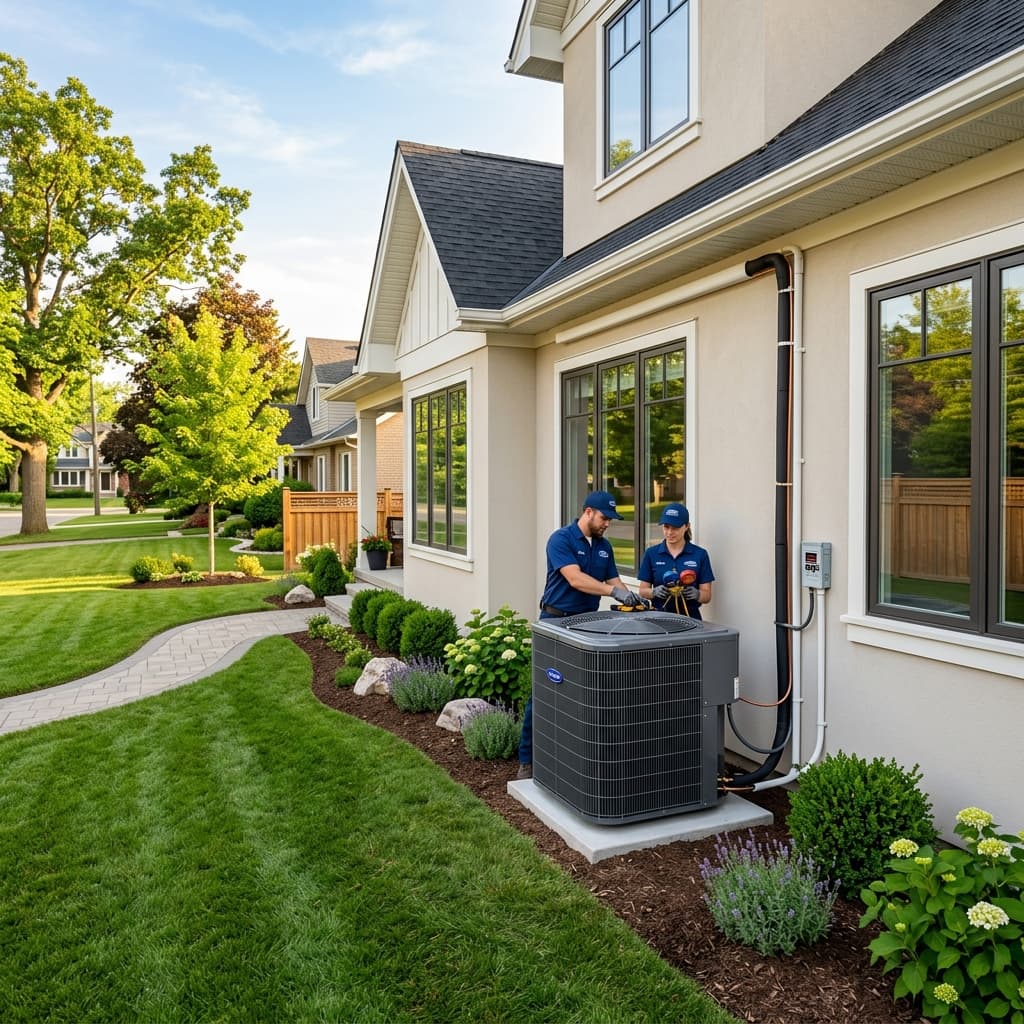
HVAC Sizing Guide 2026: Stop Guessing, Start Calculating
Quick Answer: HVAC Sizing Guide 2026: Stop Guessing, Start Calculating
Key Takeaways
- The new SEER2 standard (2023) rates equipment under more realistic conditions, making old SEER ratings obsolete for comparison.
- The "500 sq ft per ton" rule of thumb fails in over 70% of modern homes and leads to costly oversizing.
- Manual J load calculations are the ONLY accurate way to size HVAC equipment, accounting for climate zone, insulation, windows, and air sealing.
- Oversized systems waste $400-$800/year in electricity, reduce lifespan by 30-40%, and fail to dehumidify properly.
- Always demand a written room-by-room Manual J report from contractors—it should be free and is essential for proper sizing.
Introduction: The Stakes Have Never Been Higher
In 2026, getting your HVAC sizing wrong isn't just uncomfortable—it's financially devastating. With new SEER2 efficiency standards, rising energy costs, and increasingly extreme weather, the gap between a correctly sized system and an incorrectly sized one has widened from "annoying" to "wallet-destroying."
The average HVAC replacement costs $7,000 to $12,000. Yet most homeowners spend less time researching this purchase than they do choosing a new smartphone. They trust their contractor to "know best," unaware that the contractor's shortcuts—specifically, skipping the Manual J load calculation—will cost them thousands in wasted energy over the next 15 years.
This guide cuts through the industry noise and gives you the exact knowledge you need to ensure your 2026 HVAC installation is sized correctly, runs efficiently, and keeps you comfortable for the next decade and beyond.
HVAC Sizing Basics: Understanding BTUs and Tonnage
Before we dive into the complex math of Manual J, we must first master the vocabulary of HVAC sizing. The industry uses two primary units of measurement: BTUs and Tons.
A BTU (British Thermal Unit) is the amount of heat required to raise the temperature of one pound of water by one degree Fahrenheit. In HVAC terms, it measures how much heat a system can remove (cooling) or add (heating) to your home in one hour. A small window AC unit might provide 5,000 BTUs, while a whole-home furnace might provide 100,000 BTUs.
A Ton is simply a larger unit of cooling capacity. One ton is equal to 12,000 BTUs per hour. The term "ton" originates from the pre-electricity era when cooling was accomplished with large blocks of ice; one "ton" of cooling is the amount of heat energy required to melt one ton of ice in a 24-hour period. Most residential systems range from 1.5 tons (18,000 BTUs) to 5.0 tons (60,000 BTUs).
Why 2026 is Different from Previous Years: The Efficiency Evolution
Three major shifts have made 2026 a critical year for HVAC sizing. The industry has moved from "analog" estimation to "digital" precision, and the financial consequences of getting it wrong have quadrupled.
1. SEER2 Testing Standards (Effective 2023)
The old SEER rating system tested equipment under unrealistic conditions with minimal airflow resistance. SEER2 testing uses 5x higher static pressure to simulate real-world ductwork with dirty filters and turns. This means:
- A unit rated "14 SEER" under the old system is now approximately 13.4 SEER2.
- Equipment performance is now rated more honestly, but comparisons to pre-2023 units are misleading.
- You cannot simply "match tonnage" from your old system without accounting for these changes.
2. Regional Minimum Efficiency Requirements
The DOE now mandates different minimum SEER2 ratings based on geographic region:
- North (Cold Climates): 13.4 SEER2 minimum
- South (Hot Climates): 14.3 SEER2 minimum
- Southwest (Desert): 14.3 SEER2 + higher EER requirements
These minimums eliminate the cheapest, least efficient units. Your new baseline is more expensive but more efficient.
3. Variable-Speed Technology is Now Standard
High-efficiency units (16+ SEER2) almost universally use variable-speed compressors and blowers. These systems must be sized correctly to unlock their efficiency. An oversized variable-speed unit still short-cycles and wastes energy.
How SEER2 Affects Sizing Decisions
SEER2 doesn't change how you calculate your load (Manual J), but it changes which equipment you select after the calculation.
Under the old system, a contractor might say: "You need 3 tons of cooling. Here's a 14 SEER unit for $4,500 or an 18 SEER unit for $7,000."
In 2026, that same conversation is:
- "You need 3 tons. The minimum legal option is 14.3 SEER2 for $5,200."
- "For $7,500, we can install an 18 SEER2 variable-speed unit that will save you $400/year on electricity."
The upfront cost has increased, but so has the urgency to size correctly. There's no "cheap backup option" anymore.
Manual J vs. The Rule of Thumb: Why One Works and One Fails
The "500 Sq Ft Per Ton" Myth
You've probably heard: "Just take your square footage and divide by 500 to get the tonnage."
This rule assumes:
- 8-foot ceilings
- Average insulation (R-13 walls, R-30 attic)
- Average windows (U-factor 0.35)
- Moderate climate
- No cathedral ceilings, no bonus rooms, no sun-facing walls
The problem? Modern homes vary wildly. A 2,000 sq ft home in Phoenix with terrible insulation might need 5 tons. The same home in Seattle with spray foam insulation might only need 1.5 tons.
What Manual J Actually Does
Manual J is a room-by-room heat gain/loss calculation that accounts for:
- Climate Zone Design Temperatures: Your location's 99% summer and winter extremes.
- Building Envelope: Insulation R-values for walls, attic, floors.
- Windows and Doors: Quantity, orientation, shading, and U-factor/SHGC ratings.
- Infiltration (Air Leakage): How "tight" your home is.
- Internal Gains: Occupants, appliances, lighting.
- Ductwork Location: Conditioned vs. unconditioned space.
The output is a precise BTU load for heating and cooling. You then convert BTUs to tonnage (12,000 BTU = 1 ton).
| Method | Accuracy | Time Required | Cost to Homeowner | Result |
|---|---|---|---|---|
| Rule of Thumb | 30% accuracy | 5 minutes | Free (part of quote) | 70% oversized |
| Manual J | 95% accuracy | 45-90 minutes | $0-$200 (should be free) | Correctly sized |
Your Climate Zone Dictates Your Load
The DOE divides the US into 7 Climate Zones. Your zone determines the "design temperatures" used in Manual J.
- Zone 1 (Miami): 92°F cooling, 44°F heating. Cooling-dominant.
- Zone 4 (Virginia): 92°F cooling, 17°F heating. Mixed.
- Zone 6 (Minnesota): 89°F cooling, -10°F heating. Heating-dominant.
These temperatures dictate the worst-case scenario your system must handle. A home in Zone 6 needs a much larger furnace but a smaller AC than the same home in Zone 1.
The 5 Most Common Sizing Errors in 2026: A Deep Dive
Even in the age of advanced software, many contractors fall back on outdated habits. Here is why those habits are dangerous for your budget:
1. Matching the Old Unit's Tonnage (The Replacement Trap)
Your old 4-ton AC was probably oversized by 30-50%. Replacing it with another 4-ton unit perpetuates the problem. Always start fresh with a Manual J.
2. Ignoring Home Improvements
Did you add insulation? Replace windows? Air seal the attic? These changes reduce your load significantly. Your new system should be smaller than the old one.
3. Oversizing "Just to Be Safe" (The Liability Buffer)
Contractors often fear "no-cool" calls on the hottest day of the year. To protect themselves, they add a 0.5 or 1.0-ton "safety buffer" to their estimate. However, this buffer is a direct tax on your energy efficiency. In 2026, variable-speed equipment can mitigate some oversizing, but it is not a cure for a fundamentally miscalculated load. A properly sized AC should run almost continuously on the hottest day of the year (99% design day). This is by design—it means the system is perfectly balanced against the heat gain of the structure.
4. Using Online Calculators Without Local Data
Generic online calculators are better than the rule of thumb, but they often use national averages instead of your specific Climate Zone design temperatures. Use tools that ask for your ZIP code.
5. Skipping Ductwork Evaluation
Even a perfectly sized unit will fail if connected to undersized, leaky ductwork. Manual D (duct sizing) should accompany Manual J.
The Step-by-Step Sizing Process: From Survey to Selection
Proper sizing is a scientific process that follows a specific sequence of operations. In 2026, a professional "Manual J" calculation involves the following seven critical steps:
- The Physical Audit: The contractor must walk through every room of your home. They should measure wall lengths, ceiling heights, and floor area. They also need to identify the orientation of the home (which way the front door faces) to account for solar gain.
- Insulation Verification: The "R-Value" of your attic and wall insulation is the biggest driver of heat loss and gain. A home with R-60 attic insulation requires significantly less cooling tonnage than a home with R-19.
- Window and Door Inventory: Not all windows are created equal. The contractor must count every window and identify its type (single pane, double pane, Low-E coating). They also account for "SHGC" (Solar Heat Gain Coefficient), which measures how much heat from the sun passes through the glass.
- Air Infiltration Assessment: This measures how "leaky" your home is. Modern homes with spray foam are "Tight," while 1950s ranch homes are often "Loose." This factor alone can change your sizing by a full ton.
- Internal Heat Load: Who lives in the home? A family of six with two ovens and a home server rack generates much more internal heat than a retired couple.
- The Software Run: All these variables are entered into ACCA-approved software (like Wrightsoft or CoolCalc). The software runs thousands of simulations to determine the "Sensible" and "Latent" heat loads.
- Equipment Selection (Manual S): Once the load is known, the contractor uses "Manual S" to choose a piece of equipment that matches that specific load. This ensures the unit is not just powerful enough, but also has the right airflow characteristics for your ducts.
HVAC Sizing by Home Size (Estimated Ranges)
While we emphasize that every home is unique, it is helpful to understand the general ranges of capacity required for different home sizes in a moderate climate. If a contractor suggests a unit far outside these ranges, you should ask for a detailed explanation.
| Home Square Footage | Estimated Tonnage | BTU Cooling Capacity |
|---|---|---|
| 600 - 1,000 sq ft | 1.5 Tons | 18,000 - 24,000 |
| 1,000 - 1,500 sq ft | 2.0 - 2.5 Tons | 24,000 - 36,000 |
| 1,500 - 2,000 sq ft | 2.5 - 3.5 Tons | 30,000 - 48,000 |
| 2,000 - 2,500 sq ft | 3.5 - 4.5 Tons | 42,000 - 60,000 |
| 2,500 - 3,000 sq ft | 4.5 - 5.0 Tons | 54,000 - 72,000 |
Professional vs. DIY Calculations: Can You Do It Yourself?
With the rise of online tools like our HVAC Load Calculator, many homeowners wonder if they can skip the professional audit entirely. The answer depends on your goal.
- DIY Calculation: Excellent for establishing a baseline, verifying a contractor's honesty, and estimating your budget. If your DIY calculation says 2.5 tons and a contractor says 4.0 tons, you know there is a major discrepancy that needs to be explained.
- Professional Calculation: Mandatory for the actual installation. A professional contractor carries the liability for the system's performance. They also have the tools to measure Duct Static Pressure, which a homeowner cannot do. In 2026, we recommend the "Trust but Verify" approach: use our tools to know your number, then demand the contractor show you theirs.
How to Size Your System Correctly in 2026
Step 1: Demand a Written Manual J Report
When getting quotes, explicitly ask: "Will you provide a room-by-room Manual J load calculation?"
A real report will be 5-15 pages and include:
- Room-by-room BTU loads
- Total heating and cooling loads
- Specific R-values, window counts, and infiltration rates
If the contractor says "I eyeballed it" or "I've been doing this 20 years," walk away.
Step 2: Use Our Free HVAC Load Calculator
Get a baseline calculation before talking to contractors. This empowers you to question suspicious recommendations.
Step 3: Get 3 Quotes and Compare Tonnage
If all three contractors recommend different tonnages, someone is wrong. Push for explanations and load calculation reports.
Step 4: Verify Post-Installation
After installation, ask the contractor to measure:
- Airflow (CFM): Should be 350-450 CFM per ton.
- Superheat/Subcooling: Confirms proper refrigerant charge.
- Static Pressure: Verifies ductwork isn't choking the system.
The Cost Implications of Wrong Sizing: Beyond the Bill
If you think an oversized unit is just "extra insurance," you are mistaken. The cost of oversizing is cumulative and affects every aspect of your home life:
- The Comfort Tax: An oversized unit cools the air so fast that it satisfies the thermostat before it can remove moisture. This leaves your home at 72°F but with 65% humidity—a "cold and clammy" feeling that leads to mold growth and dust mite infestations.
- The Lifespan Tax: HVAC components (specifically the compressor and the blower motor) experience 80% of their wear-and-tear during the first 60 seconds of operation (the "Startup Cycle"). An oversized unit cycles on and off 10 times an hour, while a correctly sized unit cycles 2 times. The oversized unit will fail 5 to 7 years earlier.
- The Noise Tax: Oversized units require higher airflow to move the cold air. This results in loud "whooshing" sounds at the registers and a "clunk" every time the system starts up.
Conclusion: Stop Guessing, Start Calculating
2026 has eliminated the margin for error in HVAC sizing. With higher equipment costs, stricter efficiency standards, and increasingly volatile weather, "good enough" is no longer acceptable.
A Manual J load calculation is not a luxury—it's a necessity. Demand it from your contractor. Verify it with our calculator. And never, ever accept "500 sq ft per ton" as gospel.
Your comfort, your wallet, and your home's energy efficiency depend on it. By taking the time to understand the science of Manual J and the honesty of SEER2, you are joining the top 10% of informed homeowners who manage their property like a professional asset. Your reward will be lower bills, fewer repairs, and a home that feels exactly the way you want it to—no matter how hot or cold it gets outside.
Sources
Frequently Asked Questions
About the Author: Jameson Miller
Jameson Miller has over 15 years of experience in the home construction and finance industries. As a lead consultant for major residential projects and a certified financial analyst, he specializes in making complex home improvement decisions simple and data-driven. His work ensures that HomeCalc Pro provides homeowners with the most accurate, industry-standard calculations available today.