

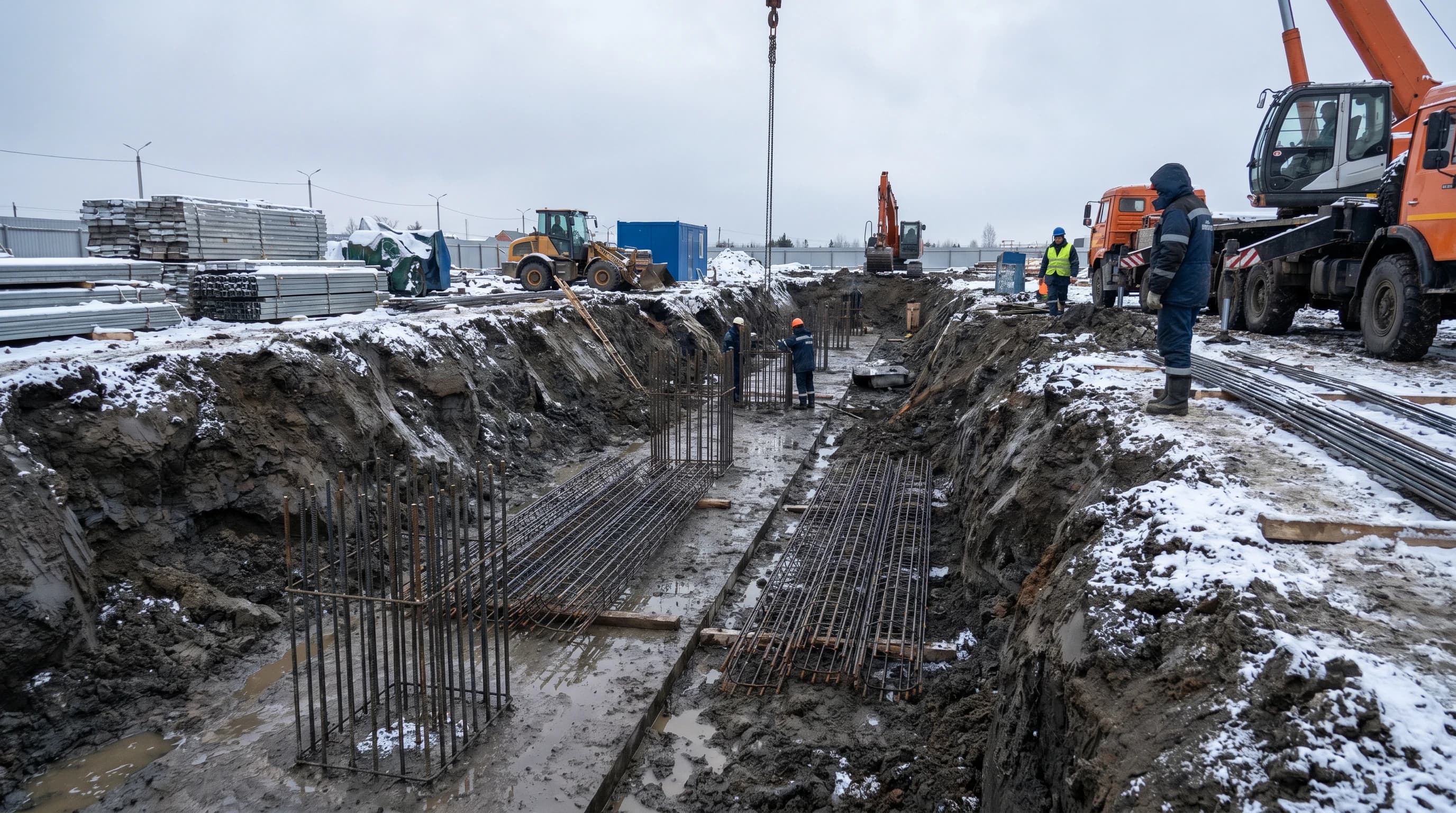
Foundation Footing Depth for Cold Climates: 2026 IRC Rules
Quick Answer: Foundation Footing Depth for Cold Climates: 2026 IRC Rules
Key Takeaways
- IRC Section R403.1.4 requires all exterior footings to be placed at or below the local frost depth to prevent frost heave.
- Frost depth can range from 0 inches in the South to over 60 inches in the far North and varies significantly by county.
- For heated basements in cold climates, the code may allow for shallower footings if properly insulated to prevent ground freezing near the foundation.
- A thickened-edge monolithic slab is a common foundation type in cold climates where a deep footing is integrated into the slab edge.
- Always consult your local building department for the official, legally required frost depth in your specific jurisdiction before any excavation.
If you live in a region with freezing winter temperatures (like Climate Zones 4-8), specific building codes dictate how deep your concrete footings must be. This isn't just red tape; it's physics.
In regions with freezing winter temperatures, the single most critical rule of foundation construction is to place footings below the frost line. Failure to do so can lead to a powerful, destructive phenomenon known as frost heave, which can lift, crack, and destroy a home's foundation. This guide breaks down the International Residential Code (IRC) requirements, the physics of frost action, and advanced mitigation strategies for cold-climate foundations.
The IRC Mandate: Understanding Frost Protection Rules
The International Residential Code (IRC) Section R403.1.4.1 is the definitive authority on how we must protect our structures from the freezing earth. It is unequivocal: "Except where otherwise protected from frost, foundation walls, piers and other permanent supports of buildings and structures shall be protected from frost by one or more of the following methods:
- Extending below the frost line: This is the most common method, requiring the bottom of the footing to be deeper than the maximum expected frost depth for the locality.
- Constructing in accordance with ASCE 32: This standard covers "Frost Protected Shallow Foundations" (FPSF), which use insulation rather than depth to protect the footing.
- Erecting on solid rock: If you hit bedrock, you are naturally protected from frost heave as the rock does not contain the moisture needed for ice expansion.
Always maintain a gap between the top of the concrete pier and the soil so the wood post isn't sitting in moisture. Use a galvanized post base standoff.
For almost all residential construction, method #1 is the industry standard. The "frost line" or "frost depth" is the depth to which the ground in a specific area is expected to freeze during the winter. This depth is determined by local building departments and is legally mandated based on historical climate data and soil temperature studies.
The frost line depth varies wildly depending on your zip code. It is determined by the local building authority based on historical climate data. You usually can't just guess; you need to check your specific town or county code.
The Physics of Destruction: What is Frost Heave?
Frost heave is more complex than simple water-to-ice expansion. While water does expand by about 9% when it freezes, the truly destructive force comes from a process called cryogenic suction. As water in the upper layers of the soil freezes, it creates a vacuum that pulls liquid water from the warmer soil below. This water then freezes, forming "ice lenses"—thick layers of ice that grow and push the soil upwards.
These ice lenses can exert a pressure of up to 60,000 pounds per square foot (psf), which is far more than enough to lift a standard two-story house. If a foundation footing is placed above the frost line, this force will lift the footing and the structure it supports unevenly. When the ground eventually thaws in the spring, the footing often does not settle back into its original position due to soil falling into the void created by the lift. This leads to a cumulative series of failures:
When the ground freezes, water in the soil expands. This expansion creates massive upward force, known as "frost heave." If your deck footings are sitting in the frozen zone, this force will lift them. When the ground thaws, they might settle back down, but rarely to the exact same spot. Over a few seasons, this heaving and settling wrecks the structural integrity of your deck. It causes ledger boards to pull away from the house (a major safety hazard), posts to lean, and joists to twist. To prevent this, the bottom of your footing must be below the frost line—the depth where the ground physically doesn't freeze.
- Structural Cracking: Horizontal or stair-step cracks in concrete blocks or poured concrete foundation walls.
- Mechanical Misalignment: Doors and windows that suddenly stick, won't close, or show large gaps at the top.
- Drywall Cracks: Spontaneous cracking of interior drywall at corners and near ceiling joints as the framing shifts.
- Foundation Rotation: In severe cases, the entire wall may tilt or rotate as the frost pushes from the side as well as the bottom.
Example: If your local code says the frost depth is 42 inches, your footing's base needs to be at least 42 inches below grade (the soil surface).
Not All Soils Are Equal: The Role of Porosity
The severity of frost heave is heavily dependent on your soil type. Soils are generally classified by their "frost susceptibility":
- Highly Susceptible (Silt and Clay): These fine-grained soils are the most dangerous. They have high "capillary action," meaning they act like a wick, pulling water from the water table up to the freezing front.
- Moderately Susceptible (Sand with Fines): Sands that contain a significant amount of silt or clay can still experience heave if moisture levels are high.
- Non-Susceptible (Clean Gravel and Coarse Sand): These soils are porous enough that water drains away quickly and there is no capillary action to grow ice lenses. Building on a thick base of compacted gravel is a common way to reduce frost risk.
Exceptions for Heated Basements: The Thermal Advantage
The IRC code states "Except where otherwise protected from frost." A heated basement is a form of frost protection. Because the basement is heated, heat continuously leaks through the foundation walls and floor into the surrounding soil. This "thermal plume" keeps the soil immediately adjacent to the foundation above 32°F (0°C), preventing frost from reaching the footing.
In these specific cases, some jurisdictions permit footings to be placed slightly shallower than the full local frost line. However, this exception requires careful engineering and often involves the use of exterior foundation insulation (XPS or EPS foam) to direct heat toward the footing and ensure the "frost line" stays above the bottom of the concrete. This approach should never be a DIY guess; it must be designed by a structural engineer and approved by the local building official.
Thickened-Edge Slabs and Monolithic Pours
Another common technique in cold climates, especially for garages and low-rise additions, is the "thickened-edge" or "monolithic" slab. Instead of a separate footing and foundation wall, the footing is integrated into the perimeter of the concrete slab itself in a single pour.
- The outer edge of the slab is poured much thicker (often 12-24 inches) and wider than the interior of the slab (typically 4-6 inches).
- This thickened edge acts as the structural footing, distributing the building's load across a larger area.
- For these to be legal in cold climates, they must either be dug below the frost line (which can result in a very deep edge) or follow the ASCE 32 standard for Frost Protected Shallow Foundations.
- FPSF design uses rigid foam insulation both horizontally (extending out from the building) and vertically against the exterior of the thickened edge. This insulation "traps" the earth's natural geothermal heat, keeping the ground under the slab from freezing.
| Soil Type | Frost Heave Potential | Primary Risk |
|---|---|---|
| Clean Gravel | Very Low | Minimal; water drains freely. |
| Coarse Sand | Low | Low, unless the water table is extremely high. |
| Silt / Silty Clay | Extremely High | Major ice lens growth due to capillary action. |
| Peat / Organic | High | High water retention and low bearing capacity. |
Detached Structures are Not Exempt
Professional Best Practices for Cold-Climate Excavation
- Clear the Area: Remove all organic material (topsoil, roots) before digging. Frost heave is exacerbated by the presence of organic matter which holds water.
- Maintain Clean Footing Bottoms: Ensure the bottom of your trench or pier hole is clean, level, and undisturbed. Poured concrete should sit on native, compacted soil or a structural gravel base.
- Manage Surface Water: Grade the area around your foundation to slope away from the structure. The less water that reaches your footings, the less ice can form.
- Use Filter Fabric: When backfilling with gravel, use a geotextile filter fabric to prevent native silts and clays from migrating into your clean gravel base and clogging the drainage.
Don't Guess, Verify with the Experts
Foundation design in cold climates is not just a building requirement; it is a long-term insurance policy for your home. Never assume a depth based on what a neighbor did or what a generic website says. Before you even rent a shovel or a backhoe, you must contact your local building department to verify the legally required frost depth for your specific address.
Cutting corners on footing depth is one of the most catastrophic and expensive mistakes a builder or homeowner can make, as foundation repairs often cost five to ten times more than doing it right the first time. Always build to code, ensure your sub-grade is well-drained, and when in doubt, consult a licensed structural engineer to review your soil conditions and foundation plan.
Sources
Frequently Asked Questions
About the Author: Jameson Miller
Jameson Miller has over 15 years of experience in the home construction and finance industries. As a lead consultant for major residential projects and a certified financial analyst, he specializes in making complex home improvement decisions simple and data-driven. His work ensures that HomeCalc Pro provides homeowners with the most accurate, industry-standard calculations available today.