

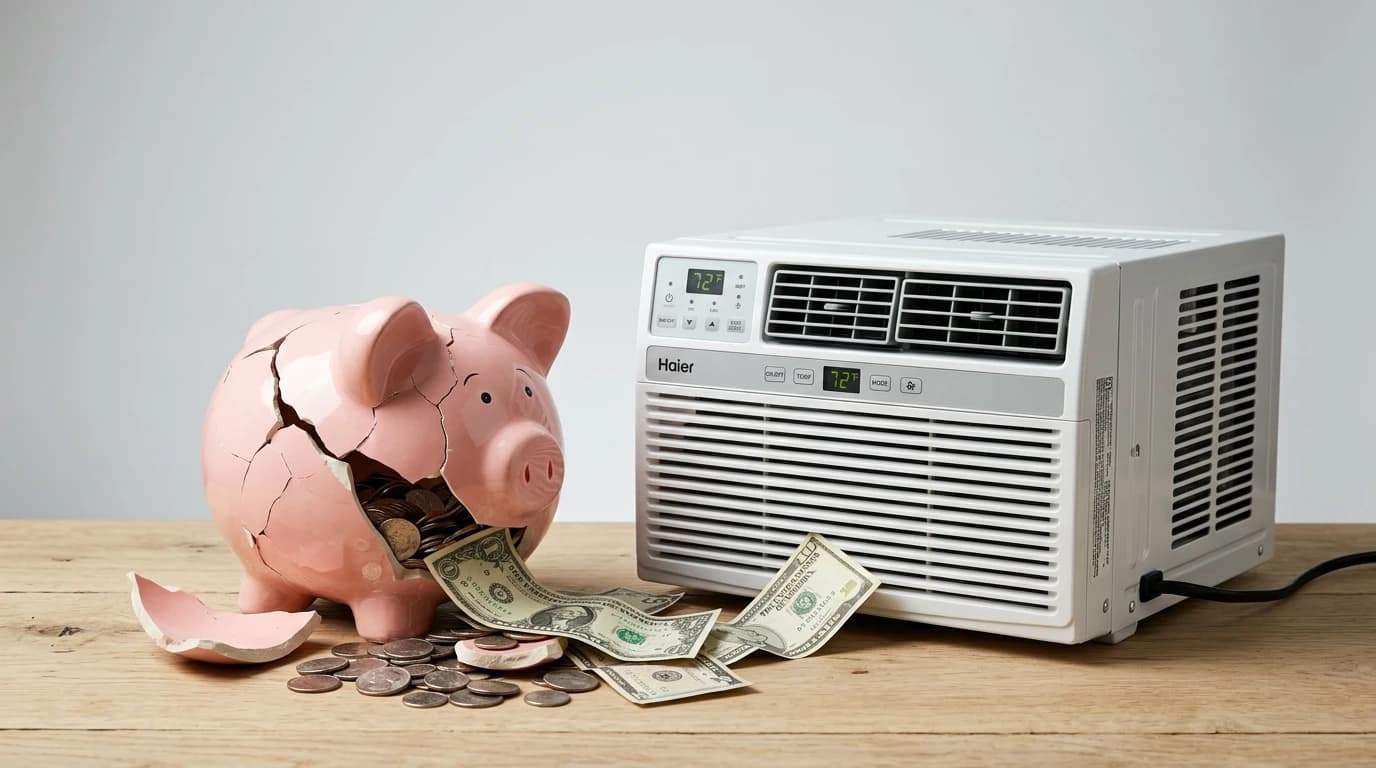
The Hidden Costs of Oversized Air Conditioners (And How to Avoid Them) 2026
Quick Answer: The Hidden Costs of Oversized Air Conditioners (And How to Avoid Them) 2026
Key Takeaways
- Oversized AC costs $400-800 more per year in electricity due to massive energy spikes at startup and poor efficiency.
- Short cycling (constant on/off) reduces equipment lifespan by 30-40%, forcing a replacement years early.
- Oversizing prevents dehumidification, leaving your home cold, clammy, and at risk for mold.
- Variable-speed units can mitigate slight oversizing, but a proper Manual J calculation is still essential.
- A perfectly sized AC should run for long, steady cycles, and may run almost constantly on the 2-3 hottest days of the in-year—this is a sign of correct sizing, not a flaw.
You know that cold, clammy feeling in your house, even when the AC is blasting? That isn't a sign of power; it's the #1 symptom of a massive, costly problem: an oversized air conditioner.
For decades, the HVAC industry has been dominated by a "bigger is better" mentality, often driven by outdated rules of thumb. But the simple truth is that an AC unit that's too large for your home is an energy killer, a comfort destroyer, and a hidden drain on your wallet.
If your system was sized using a "square footage only" guess, you likely have an oversized unit. This single mistake triggers a cascade of failures: your power bill goes up, your comfort goes down, your home's air quality suffers, and you’ll be buying a replacement system years sooner than you should.
The Efficiency Killer: Understanding Short Cycling
The most immediate and costly problem with an oversized AC unit is short cycling. To understand it, think of your AC like a car.
A properly sized unit is like a car on the highway, running at a steady, efficient speed for a long-distance trip. An oversized unit is like a drag racer in rush hour traffic: flooring it for 10 seconds (a massive surge of power), slamming the brakes, and repeating the process every two minutes.
Why this wastes so much energy:
Starting a compressor motor is the single most energy-intensive part of the cooling cycle. It draws a massive spike of electricity, known as inrush current, to overcome inertia and charge the system's capacitors.
- A properly sized unit might start 2-3 times per hour on a hot day, running for long, 15-20 minute cycles. It minimizes those high-energy startups.
- An oversized unit might start 10-12 times per hour, running for only 3-5 minutes. It maximizes the number of high-energy startups, causing your electric meter to spin.
This repetitive, high-stress process is the primary reason oversized AC units cost homeowners $400 to $800 more per year in electricity bills. The system spends all its time starting, never reaching the "efficient highway speed" it was designed for.
The Comfort Thief: Chronic Humidity Problems
This is the problem you can feel. Your thermostat reads 72°F, but you're reaching for a sweater because the air feels cold, damp, and sticky. This is a direct failure of an oversized system.
Your AC has two jobs: cool the air (sensible cooling) and remove moisture (latent cooling). It fails at the second job because of time.
Here's the science:
- Reaching the Dew Point: To remove humidity, the indoor evaporator coil must become cold enough to drop below the air's dew point—the temperature at which moisture condenses out of the air (just like on a cold glass of water).
- Sustained Operation: This coil needs to stay below the dew point for a sustained period. Moisture slowly condenses, beads up, and finally drains away. This process requires a long, stable run time.
An oversized unit short cycles (running for only 3-5 minutes), so the evaporator coil never gets and stays cold enough for effective condensation. It might chill the air (sensible cooling), but it leaves all the moisture behind.
The impact of high humidity:
- Physical Discomfort: You feel cold and damp, forcing you to set the thermostat even lower (e.g., to 69°F) to feel comfortable, which worsens the short cycling and wastes even more energy.
- Health and Home Risks: Chronic high humidity (above 60%) is the perfect breeding ground for mold, mildew, and dust mites. You'll notice musty smells and risk hidden mold growth behind walls and in your ductwork. The U.S. EPA notes that controlling moisture is the key to preventing mold. (See: EPA Guide to Mold and Moisture in Your Home).
A properly sized unit that runs for 15-20 minutes at a time will pull gallons of water from your air, allowing you to feel perfectly comfortable at a higher, energy-saving temperature like 76°F.
The Lifespan Destroyer: Equipment Wear and Tear
The repeated, harsh cycle of starting and stopping an oversized AC unit doesn't just waste electricity; it physically destroys the components.
It's the mechanical equivalent of doing 500 wind sprints instead of a 3-mile jog. The stress is enormous, and the components that bear the brunt are:
- The Compressor Motor: This is the heart of your AC. Every start-up sends a jolt of electricity that heats up the motor windings. Without a long run time to cool down, this built-up heat degrades the motor's insulation, leading to premature burnout.
- The Compressor Contactor: This is the high-voltage switch that turns the compressor on. Cycling 12 times an hour instead of 3 means it's doing 4x the work it was designed for. The electrical contacts arc, pit, and eventually weld themselves together or fail completely.
Lifespan Reduction:
A correctly sized, high-quality AC unit should last 15 to 20 years. An oversized unit subject to constant short cycling often fails in 9 to 12 years. This reduction of 30-40% means you are prematurely facing a $5,000 to $10,000 replacement cost, all because of a bad calculation on day one.
How to Protect Yourself and Demand Accuracy
The core solution lies in the sizing process. Why do contractors still use the outdated "500 sq ft per ton" rule? It's fast, easy, and it guarantees they won't get an angry callback for an undersized unit (which is a much more obvious and immediate complaint). It's a business shortcut that costs you money.
You must demand accuracy.
- Demand the "Manual J" Calculation: Never accept a quote without a clear, written Manual J Residential Load Calculation. This is the industry-standard method that accounts for your home's actual features: insulation R-values, window types (U-factor), duct location, home orientation, and local climate data. If a contractor resists or scoffs at this, that is a disqualifying red flag.
- Ask About Variable-Speed Systems: Modern technology offers a partial solution. Two-stage or variable-speed units can "ramp down" to run at 30-70% of their full capacity. This means a 4-ton unit can run like a 1.5-ton unit on a mild day, allowing for long, efficient, dehumidifying cycles. While this technology is more forgiving of slight oversizing, it is not a substitute for a proper Manual J.
- Get Multiple Opinions: Obtain at least three quotes and compare the recommended tonnage and the Manual J inputs. If one contractor recommends 3.5 tons and another recommends 5 tons for the same house, one of them is significantly wrong.
Do This / Avoid This
Do This
- Demand a written Manual J calculation with every single quote.
- Use our HVAC Load Calculator to get an unbiased estimate of your tonnage range before you call a pro.
- Prioritize high R-value insulation before you replace your AC unit to potentially reduce the size you need.
Avoid This
- Don't accept the "500 sq ft per ton" rule—it is a recipe for failure.
- Never assume "bigger is better" for HVAC equipment.
- Don't ignore the humidity; it's a sign of a deep, costly problem.
Cost Breakdown
| Issue | Annual Cost (Est.) | Long-Term Cost (15 Yrs) |
|---|---|---|
| Wasted Energy (Short Cycling) | $400 - $800 | $6,000 - $12,000 |
| Premature Replacement | N/A | $5,000 - $8,000 |
| Increased Repairs (Contactors, Fuses) | $100 - $300 | $1,500 - $4,500 |
| Average Total Hidden Cost | $12,500+ | |
Average Total Hidden Cost: $12,500+ over 15 years for an oversized system.
Common Questions
Q: Is my AC oversized if it runs constantly on the hottest day of the year?
A: No, that's actually what it's supposed to do! A perfectly sized unit should run almost 100% of the time on the "design day" (the 1-3% hottest days). If your AC never seems to shut off, it might be undersized, but if it only does this on the most extreme days, it's likely sized perfectly.
Q: Can I fix an oversized AC unit?
A: Unfortunately, no. You can't change the unit's capacity. The best solution is replacing it with a properly sized, variable-speed unit. Adding zones (e.g., separating upstairs/downstairs) can sometimes help by forcing the unit to run longer to cool a smaller area, but it's an expensive, complex workaround.
Q: If I replace my old AC with the same size, am I still safe?
A: Not necessarily. If you've upgraded your insulation or windows since the old unit was installed, your home's heat load is now lower. The original size may now be grossly oversized. Always recalculate.
Q: Does installing a smart thermostat help with short cycling?
A: A smart thermostat can help optimize a unit's schedule, but it cannot fix the fundamental physics problem of an oversized system. The system's capacity is still too large for the home's load.
Bottom Line
The fight against an oversized AC unit is a fight for comfort, efficiency, and equipment longevity. Don't fall for the "bigger is better" myth. By demanding a Manual J calculation and understanding the signs of short cycling, you are protecting your investment. A correctly sized system costs less to run, keeps your home drier, lasts longer, and is the single most important factor in your home's HVAC system success. Use our tools and empower yourself before you sign a contract.
Remember:
- Demand written Manual J calculations.
- Short cycling = wasted money + high humidity.
- A unit that runs for long, steady cycles is a healthy unit.
Official Sources & Resources
Frequently Asked Questions
About the Author: Jameson Miller
Jameson Miller has over 15 years of experience in the home construction and finance industries. As a lead consultant for major residential projects and a certified financial analyst, he specializes in making complex home improvement decisions simple and data-driven. His work ensures that HomeCalc Pro provides homeowners with the most accurate, industry-standard calculations available today.