

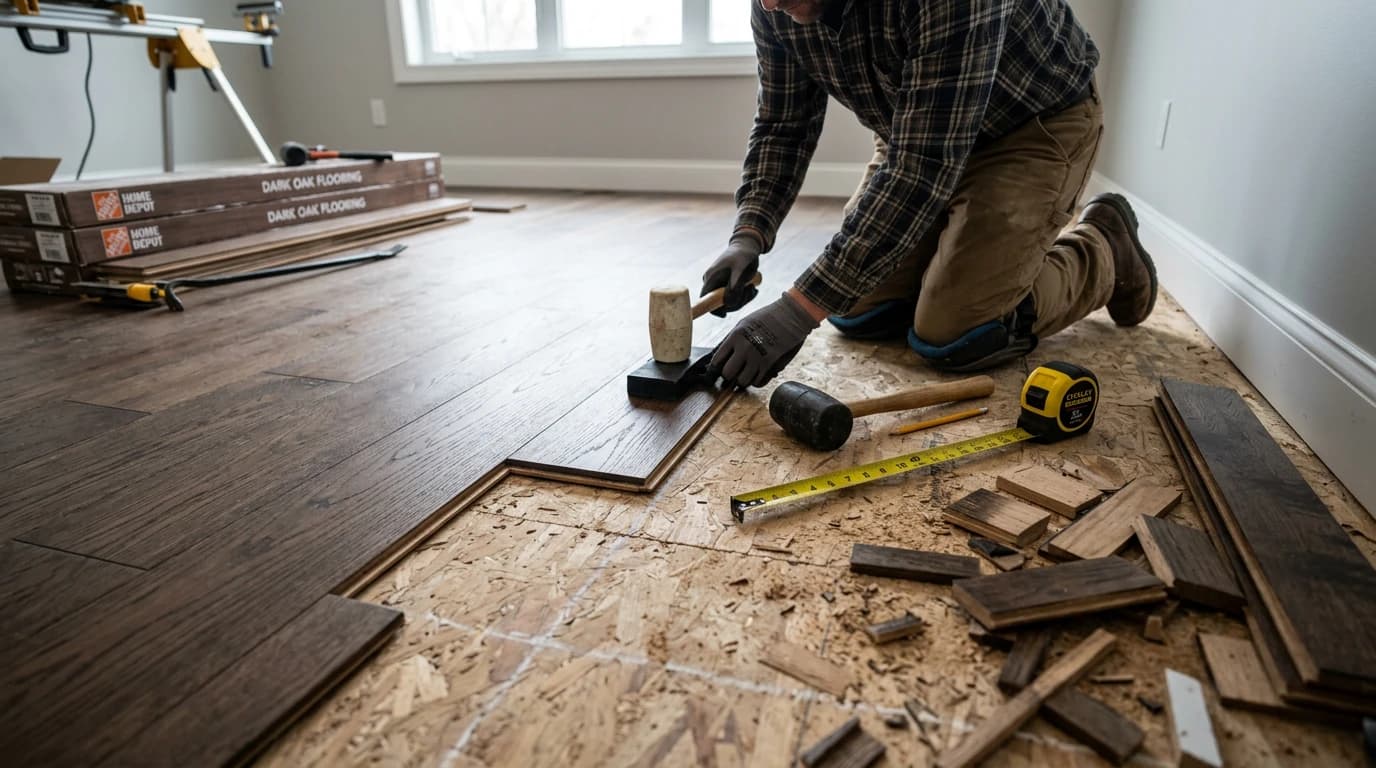
Flooring Waste Factor: Why You Need 10-15% Extra in 2026
Quick Answer: Flooring Waste Factor: Why You Need 10-15% Extra in 2026
Key Takeaways
- The standard flooring waste factor is 10% for straight-lay patterns in a simple square room.
- Diagonal, herringbone, or chevron patterns dramatically increase waste, requiring 15-20% extra material.
- Tile installation often requires 15-20% waste, especially for large format tiles or complex patterns.
- DIY installers should add an extra 5% for mistakes, bringing their total waste factor to 15-20%.
- Always buy all your flooring at once and keep one extra box (attic stock) for future repairs, as dye lots and finishes will change.
Introduction: The Nightmare of Being "One Box Short"
It is the most dreaded scenario in any home improvement project. You have spent all weekend laying your beautiful new oak hardwood floor. Your knees ache, your back is sore, but you are 95% done. You reach for the next plank to finish the hallway, and your hand hits empty cardboard. You are out of flooring.
Panic sets in. You drive to the store, but the shelf is empty. Or worse, you find the box, but the "Run Number" or "Dye Lot" is different. You install it anyway, and suddenly, your floor shifts from a warm honey oak to a slightly darker, reddish hue right in the middle of the hall. The project is ruined.
This disaster is entirely preventable. It happens not because you measured your room wrong, but because you failed to calculate the Flooring Waste Factor correctly. Calculating square footage is math; calculating waste factor is an art that accounts for mistakes, geometry, and the unpredictable nature of construction.
In this comprehensive guide, we will move beyond the standard "add 10%" advice and dive deep into the real-world variables that determine how much flooring you actually need to buy to ensure your project succeeds without a mid-installation crisis.
What is Flooring Waste Factor?
Waste Factor is the percentage of extra material you buy to account for cuts, mistakes, defects, and future repairs. When you install flooring, you don't use 100% of every square foot you buy. You cut pieces to fit against walls, around corners, and under door jambs. Those cut-off ends are often too small to be reused elsewhere. They go in the trash. That is waste.
Why? Because rooms are not perfect rectangles, flooring material is not flawless, and you cannot use every single inch of every plank.
The industry standard "rule of thumb" is 5-10%. However, this rule was created for professional installers working in square rooms with standard materials. For the average homeowner, DIYer, or complex room layout, sticking to 10% is often a gamble.
The 5 Elements of Waste
To understand why you need "extra" flooring, you have to look at where that flooring actually goes. It doesn't just disappear; it gets consumed by five specific categories of waste.
1. Cut Waste (Geometry)
When a row of flooring hits a wall, you cut the plank.
A perfectly square room with no closets or vents is the ideal scenario. You will basically only cut the planks at the two end walls. You can often reuse the cut-off piece from one row to start the next row. Efficiency is high.
Every wall, doorway, closet, and obstacle creates this "cut waste."
2. Flaw Waste (Quality Control)
No box of flooring is perfect. Even with premium A-grade hardwood, you will find planks with:
- Knots or wormholes you think are ugly.
- Splintered edges or cracked tongues.
- Finish defects or color streaks.
With natural hardwood, you might cull (discard) 5-10% of boards simply because they don't match the look you want. With LVP or Laminate, you might find 1-2 boards per box with broken clicking mechanisms from shipping.
3. Mistake Waste (Human Error)
You measure once, cut once, and realize you cut the wrong side of the line. Or you cut the angle backwards. Or you chip the laminate surface with your saw. Pros make these mistakes occasionally; DIYers make them frequently. If you are a first-time installer, your "mistake waste" will be higher than a pro's.
4. The "Box Rounding" Trap
This is the silent budget killer. You can't buy 103 square feet of flooring. You must buy full boxes. If a box covers 20 sq. ft., and you need 103 sq. ft., you must buy 6 boxes (120 sq. ft.). Suddenly, your "10% waste" has mathematically turned into 17% waste just because of packaging. We will cover this in detail below.
5. Attic Stock (Future Insurance)
This is not waste you throw away; it is waste you hoard.
Always keep at least 1 full box (or 15-20 sq ft) of material stored in your attic or garage after the project is done. Years from now, if you have a water leak, a deep scratch, or a remodel that moves a wall, you will need matching planks. Flooring products are discontinued constantly; finding a match in 5 years is often impossible. A damaged plank can force you to replace an entire room's floor.
Installation Patterns & Waste
The pattern you choose has the single biggest impact on your waste factor. A complex pattern creates significantly more unusable cut pieces.
Straight Lay (Standard)
One of the most frustrating moments in any DIY renovation is reaching the end of a flooring installation and realizing you are three planks short. It halts progress, forces a frantic trip to the store (hoping the dye lot hasn't changed), and ruins the flow of the weekend.
Waste Factor: 5-10%
This is the most common installation, where planks run parallel to the longest wall. It is the most efficient use of material.
Diagonal Lay (45-Degree)
Waste Factor: 15-20%
Installing flooring at a 45-degree angle opens up a room visuals but creates massive waste. Every single board that hits the four walls must be cut at an angle. The triangular off-cuts are often too small or the wrong angle to be reused elsewhere.
Conversely, finishing a job with 10 unopened boxes is a massive waste of money. Returning special-order flooring is often impossible or comes with a hefty restocking fee. The key to hitting the "Goldilocks" zone—just enough, with a few spares for future repairs—is understanding Waste Factor.
Herringbone & Chevron
Waste Factor: 20-25%
These classic, elegant patterns differ from standard planks. Herringbone uses rectangular blocks; Chevron uses parallelograms. Both require precise alignment. Because the pattern must be centered in the room, you lose substantial material at all four walls to maintain the symmetry. Additionally, these patterns often use "Left" and "Right" boards; if you run out of "Lefts," your "Rights" are useless.
Material Specific Guidelines: A Deep Dive
Not all flooring materials are created equal when it comes to durability, flexibility, and cutting efficiency. Understanding the unique characteristics of your chosen material is essential for setting an accurate waste factor.
Luxury Vinyl Plank (LVP) & Rigid Core (5-10% Waste)
Luxury Vinyl Plank has revolutionized the DIY flooring market because of its extreme uniformity and "score and snap" installation method. Because LVP is an engineered product, every plank is identical in color and texture. You won't find "bad boards" that need to be thrown away for aesthetic reasons. Furthermore, because you aren't using a power saw for every cut, there is less risk of chipping or shattering the material. Most professionals recommend a flat 7% for LVP in rectangular rooms.
Laminate Flooring (10-12% Waste)
Laminate is similar to LVP but typically more brittle. The top wear layer is prone to chipping if you use a dull saw blade, and the tongue-and-groove locking mechanisms can break if you are too aggressive with a tapping block. Because of this higher risk of "mechanical failure" during installation, we recommend a slightly higher 10% baseline for laminate.
Solid & Engineered Hardwood (12-15% Waste)
Hardwood is a natural product, which means it is inherently unpredictable. Even in a "Select" grade box, you will encounter planks with mineral streaks, knots, or grain patterns that don't fit the flow of your room. Additionally, hardwood is subject to "bowing" or "crowning"—where a long board is slightly curved and cannot be easily clicked into place. You will inevitably "cull" (set aside) several boards per box. For natural wood, 12% is the absolute minimum, with 15% being the safe choice for most homeowners.
Ceramic and Porcelain Tile (15-20% Waste)
Tile is the "king of waste." Unlike wood or vinyl, which can be somewhat flexible, tile is rigid and fragile. It can crack in the box during shipping, it can shatter when you try to use a manual snap-cutter, and it can chip when you use a wet saw. Furthermore, the way tile is laid (often in a 50% offset or "brick" pattern) creates many small triangular waste pieces at the edges that cannot be reused. If you are using large-format tiles (12x24 or larger), the waste factor should be at least 15% because a single mistake on one tile ruins a massive amount of square footage.
Natural Stone (20-25% Waste)
Travertine, marble, and slate have even higher waste factors than ceramic. Natural stone often has internal fissures or "fault lines" that causes it to break unexpectedly during cutting. You will also find significant color variations—some pieces may be almost white while others are dark brown. To get a floor that looks cohesive, you will need to "dry lay" the entire room and discard the pieces that are too far out of the color range.
The Financial Impact of Waste: Why "Buying Cheap" Fails
Many homeowners try to lower their project budget by cutting the waste factor down to 3% or 5%. On a $5,000 flooring order, saving 5% might seem like a quick way to keep $250 in your pocket. However, this is a classic example of being "penny wise and pound foolish."
If you run out of material, the Real Cost includes:
- Shipping Fees: Buying one or two extra boxes later often requires paying $50-$100 in specialized freight shipping because flooring is too heavy for standard ground mail.
- Labor Delays: If you have hired professional installers, they will still charge you for the day even if they are sitting around waiting for material. A "halted project" fee can easily exceed the cost of the entire waste overage.
- Retail Price Hikes: Most flooring stores give you a discount for bulk orders. Buying "fill-in" boxes later often means paying the full retail "per-box" price, which can be 20-30% higher than your initial rate.
The "Box Rounding" Trap: A Real World Example
Let's look at the math to see why 10% is often not enough.
Scenario: You have a 12x12 room (144 sq. ft.).
- Calculate Waste: You add 10% waste. 144 + 14.4 = 158.4 sq. ft. needed.
- Check Box Size: The LVP you love comes in boxes of 18.5 sq. ft.
- Calculate Boxes: 158.4 / 18.5 = 8.56 boxes.
- Round Up: You can't buy 0.56 boxes. You must buy 9 boxes.
- Total Footage: 9 boxes * 18.5 = 166.5 sq. ft.
The Reality: You started with a 144 sq. ft. room and bought 166.5 sq. ft. Your actual overage is 15.6%. If you had tried to scrimp and only buy 8 boxes (148 sq. ft.), you would have only 4 sq. ft. of waste (2.7%), which is dangerously low. Always calculate your waste first, THEN round up to the nearest full box.
Attic Stock: Future Proofing
We cannot stress this enough: Flooring is fashion. Colors, styles, and locking mechanisms change every 2-3 years.
If you install a floor today, the manufacturer will likely discontinue that specific color by 2028. If you have a spill, a pet accident, or a heavy object drop that ruins three planks in the middle of your living room, you cannot replace them unless you have spare boxes.
Recommendation: Always ensure that after installation, you have at least 1 full, unopened box left over. Store it in a climate-controlled area (closet/under bed), not a damp garage. This $50 box could save you $5,000 in future replacement costs.
Comparison Table: Recommended Waste Factors
| Material | Pattern / Type | Pro Waste % | DIY Waste % |
|---|---|---|---|
| Laminate / LVP | Straight Lay | 5-7% | 10% |
| Hardwood | Straight Lay | 10% | 12-15% |
| Any Material | Diagonal (45°) | 15% | 20% |
| Tile | Standard Grid | 10% | 15% |
| Tile | Large Format | 15% | 20% |
| Any Material | Herringbone | 20% | 25% |
Professional Tips for Minimizing Actual Waste
While you should always buy 10-15% extra, there are ways to ensure you don't actually waste that material, allowing you to keep more for your "Attic Stock."
- The 18-Inch Rule: When you cut a plank at the end of a row, if the remaining piece is 18 inches or longer, use it to start the next row. If it is shorter than 12-18 inches, the "joint" will be too close to the previous row, creating a structural and visual weak point.
- Work from Multiple Boxes: Professional installers always open 3 to 5 boxes at a time and mix the planks. This ensures that any slight color variations between boxes are blended across the entire floor, rather than having a "dark patch" in one corner of the room.
- Save Your Scraps: Never throw away a cut-off piece until the entire project is finished. You may find that a small 4-inch scrap is exactly what you need to fill the gap inside a closet or behind a toilet.
- Measure Twice, Cut Once: It sounds cliché, but the majority of DIY waste comes from cutting the "wrong side" of the mark. Always mark your cut with an arrow pointing to the "waste" side of the line.
Final Thoughts: The Peace of Mind Overage
When budgeting for your flooring project, view the "Waste Factor" not as money thrown away, but as an insurance policy. It insures you against standard construction geometry, inevitable human error, and the "discontinued product" nightmare that haunts many homeowners years later.
The cost of two extra boxes of flooring is minimal compared to the cost of stopping a project, re-ordering material, waiting for shipping, and potentially missing your installation window. Plan smart, buy extra, and enjoy the peace of mind that comes with knowing you have your project fully covered from wall to wall. By using our Flooring Calculator, you can input your specific dimensions and material type to get a scientifically-backed estimate that removes the guesswork from your next renovation.
Official Sources & Resources
Frequently Asked Questions
About the Author: Jameson Miller
Jameson Miller has over 15 years of experience in the home construction and finance industries. As a lead consultant for major residential projects and a certified financial analyst, he specializes in making complex home improvement decisions simple and data-driven. His work ensures that HomeCalc Pro provides homeowners with the most accurate, industry-standard calculations available today.