

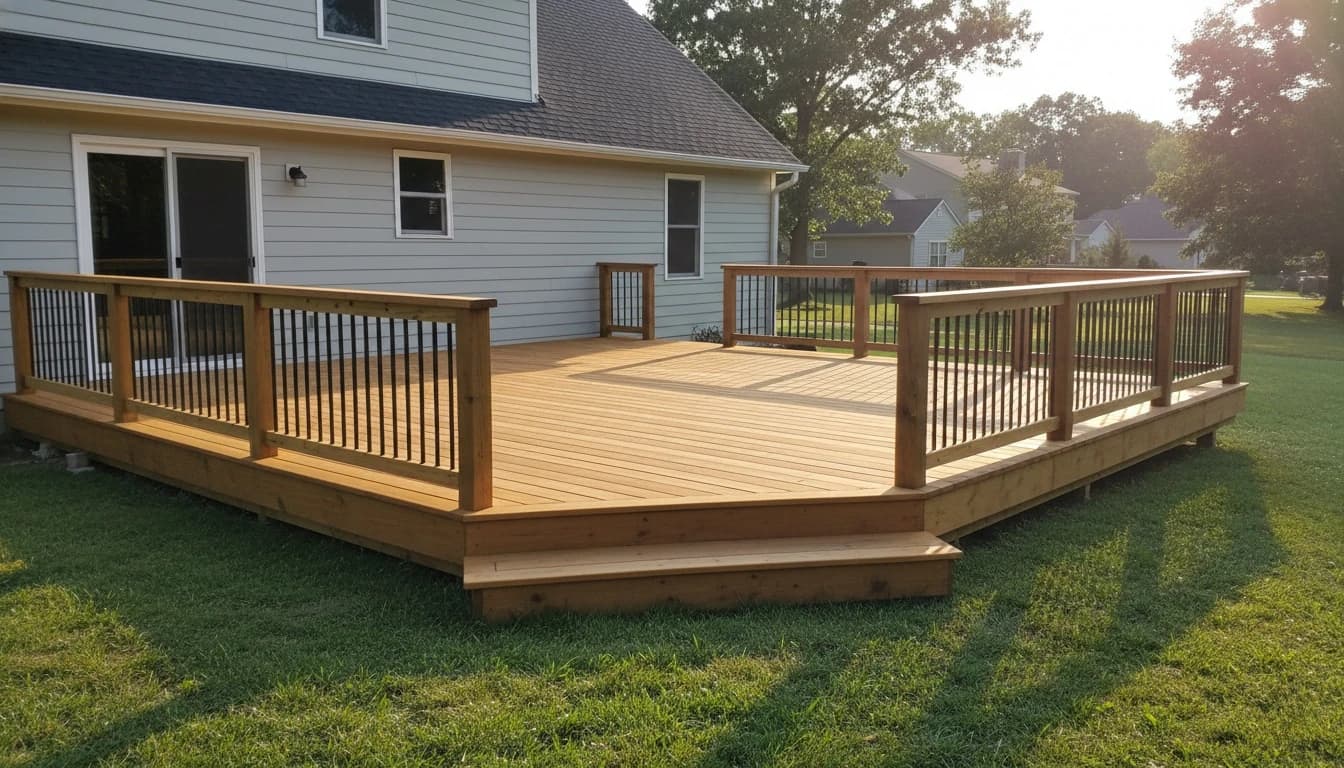
Deck Footing Depth 101: 2026 Guide to Digging Below the Frost Line
Quick Answer: Deck Footing Depth 101: 2026 Guide to Digging Below the Frost Line
Key Takeaways
- The International Residential Code (IRC) mandates that all footings, including those for decks, must extend below the local frost line.
- The frost line is the maximum depth to which soil moisture is expected to freeze in your area.
- Digging footings above the frost line leads to frost heave, where frozen soil expands, destroying the deck structure.
- Footing size (diameter or area) is determined by the deck load (weight) and the soil bearing capacity (pounds per square foot).
- Always verify the minimum required footing depth with your local building department, as frost lines can vary significantly even within a county.
A deck is only as strong as the ground it stands on. While visible elements like the cedar boards, glass railings, and hidden fasteners receive most of the attention, the crucial components ensuring the deck's longevity are hidden beneath the surface: the footings. Deck footings serve one primary, non-negotiable purpose: to safely transfer the entire load (structure, people, furniture, snow) down to stable, undisturbed soil. Getting the footing depth or size wrong can lead to structural collapse, house damage, and catastrophic liability.
The Frost Line and the Destruction of Frost Heave
The frost line is the maximum depth that groundwater in the soil is expected to freeze in a typical winter. When water in the soil turns to ice, it expands by roughly 9% in volume. This expansion creates an irresistible upward force called Frost Heave. If your footings are not deep enough, the ice will literally lift your deck out of the ground.
This upward movement is rarely uniform. One corner of the deck may lift 2 inches while the other stays put. This twists the frame, snaps the ledger bolts that attach the deck to your house, and creates "tripping hazards" as the decking boards warp. The International Residential Code (IRC) Section R403.1.4.1 mandates that "all footings shall extend below the frost line." In some parts of the US, this is as shallow as 12 inches; in the North, it can exceed 60 inches.
Calculating Your Deck's Tributary Load
Before you dig, you must know how much weight each post will carry. This is called the Tributary Area. For a square deck with four posts, each post carries 25% of the total load. If the deck is attached to the house via a ledger, the house carries half the load, and the posts carry the other half.
We use a standard design load of 50 PSF (Pounds per Square Foot). This is composed of:
- Dead Load (10 PSF): The weight of the wood, joists, and decking.
- Live Load (40 PSF): The weight of people, heavy furniture, and potential snow accumulation.
Example: If a post is responsible for a 10'x10' area of the deck (100 sq. ft.), it must support 5,000 lbs (100 sq ft x 50 PSF). This weight must be distributed over the soil at the bottom of the footing.
| Deck Component | Design Load (PSF) | Impact on Footing Size |
|---|---|---|
| Standard Wood Deck | 50 PSF | Standard (10-12" Pier) |
| Composite/Hardwood | 60 PSF | Requires +20% Bearing Area |
| Hot Tub / Spa Area | 100+ PSF | Requires Thickened "Bell" Footings |
Soil Bearing Capacity: What the Ground Can Handle
Different soils have different strengths, measured in PSF. This is why a footing diameter that works in one city might fail in another. If the soil is weak (like clay or silt), the footing must be wider to spread the load over a larger area.
- Sedimentary Rock: 4,000+ PSF (Extremely strong)
- Sand/Gravel: 2,000 - 3,000 PSF (Excellent drainage and strength)
- Clay/Silt: 1,500 PSF (Weak; often requires wide "bell" bottoms on footings)
Most building codes assume 1,500 PSF as a safe baseline. Using our 5,000 lb post example from earlier, a 1,500 PSF soil would require a footing with a surface area of 3.33 sq. ft. (5000 / 1500). That translates to a circular footing with a 24-inch diameter.
Concrete Tech: PSI, Rebar, and Curing
Don't just use "any" concrete. For structural deck footings, the PSI (Pounds per Square Inch) rating is critical. We recommend a minimum of 3,000 PSI. If you are in a severe freeze-thaw climate, 4,000 PSI is even better as it has fewer microscopic pores for water to enter and freeze.
Reinforcement: For any deck over 4 feet tall, you should place a single vertical #4 rebar in the center of the pier. This provides "tensile strength." Concrete is very strong at being squeezed (compression) but weak at being pulled or bent. Rebar prevents the pier from snapping if the soil moves laterally.
Professional Installation: The "Bell" Method
To ensure a code-compliant installation, follow these professional steps:
- Excavation: Dig your hole to the required frost depth. Use a "bell" tool or a shovel to widen the bottom of the hole. This creates a larger bearing surface on the soil while using less concrete in the main shaft.
- Gravel Base: Add 2-3 inches of crushed gravel to the bottom of the hole. This provides a "drainage plane" and a level surface for the concrete.
- Forming: Use a cardboard tube form (Sonotube) for the top 12-24 inches of the pier. This ensures the portion above ground is perfectly circular and smooth.
- The Anchor: Do not bury the wooden post in the concrete! This leads to rot. Instead, use a galvanized post base (like a Simpson Strong-Tie ABW44) that is bolted into the concrete. This keeps the wood 1 inch above the concrete, allowing it to stay dry.
Ledger Safety Warning
Conclusion: Build for the Next 30 Years
A deck should be a source of relaxation, not a source of structural anxiety. By digging below the frost line and sizing your footings based on your specific soil and load, you ensure your deck stays level and safe for the life of the home. Before you buy your first joist, use our Concrete Calculator to estimate your materials and our Deck Cost Tool to budget for a high-quality foundation.
Official Sources & Resources
Frequently Asked Questions
About the Author: Jameson Miller
Jameson Miller has over 15 years of experience in the home construction and finance industries. As a lead consultant for major residential projects and a certified financial analyst, he specializes in making complex home improvement decisions simple and data-driven. His work ensures that HomeCalc Pro provides homeowners with the most accurate, industry-standard calculations available today.