

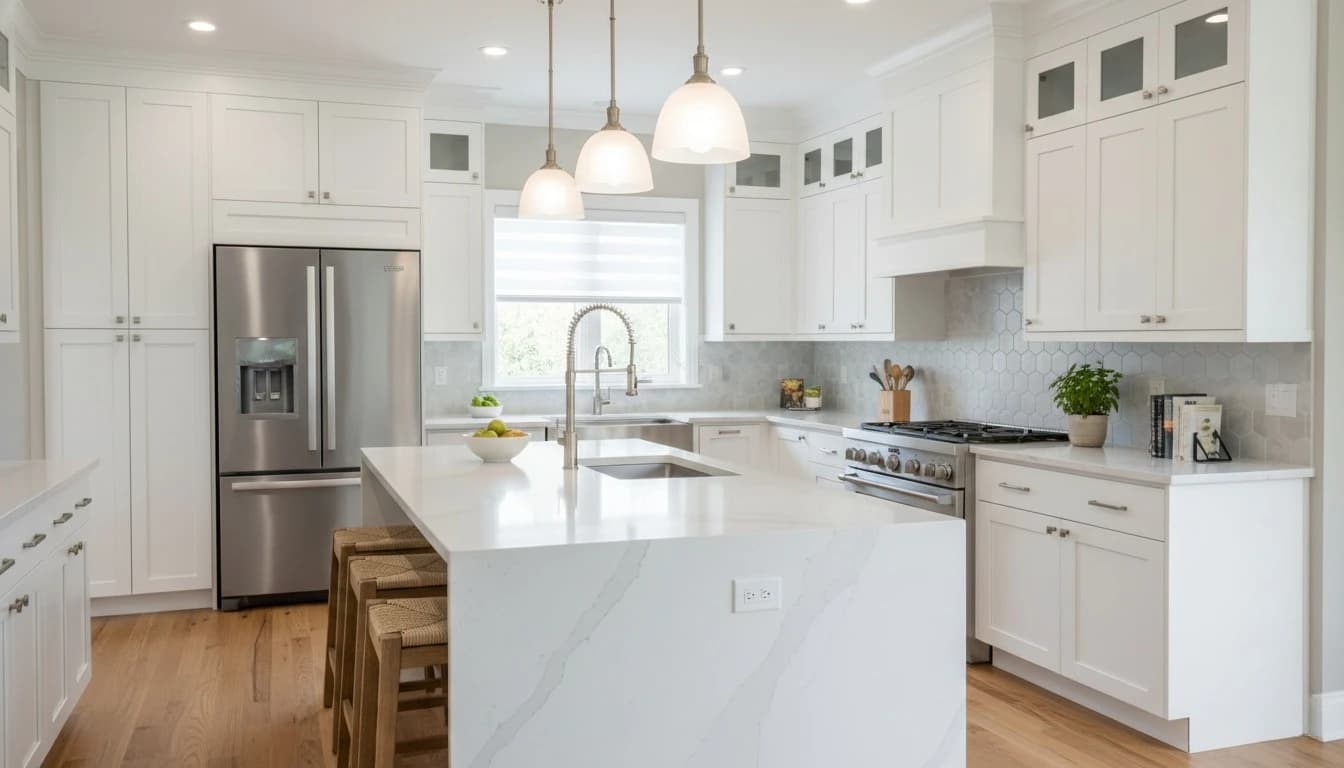
Kitchen Remodel Cost Guide 2026: Budgeting for Your Dream Space
Quick Answer: Kitchen Remodel Cost Guide 2026: Budgeting for Your Dream Space
Key Takeaways
- Cabinetry and hardware typically account for 30-40% of a total kitchen budget.
- A mid-range kitchen remodel in 2026 costs between $25,000 and $65,000.
- Keeping your existing layout can save up to $5,000 in plumbing and electrical costs.
- Induction cooktops and counter-depth refrigerators are the top appliance trends for 2026.
- A minor kitchen refresh offers a higher ROI (approx 72%) than a luxury overhaul.
Introduction: Planning Your 2026 Dream Kitchen
The kitchen is the heart of the home, often complimented by a modern bathroom remodel, but in 2026, it is also the most complex and expensive room to renovate. With inflation affecting material costs and a shortage of skilled tradespeople driving up labor rates, budgeting for a kitchen remodel has never been more challenging—or more critical.
A successful remodel isn't just about choosing the right backsplash tile or the perfect shade of navy for your cabinets. it is about understanding the actuarial reality of where your money goes. Whether you are planning a minor "refresh" to boost your home's resale value or a major "down-to-the-studs" luxury overhaul, this guide provides the transparent data you need to plan with confidence.
In this comprehensive analysis, we break down the costs of a kitchen remodel in 2026, from the 35% of your budget that will go into cabinetry (see our cabinet cost guide) to the hidden fees that catch most homeowners off guard. Our goal is to ensure your project finishes on time, on budget, and adds the maximum possible value to your property.
Average Kitchen Remodel Costs: The Four Tiers
Every kitchen is unique, but professional contractors generally categorize remodels into four distinct financial tiers based on the scope of work and the quality of finishes.
- Minor/Cosmetic Remodel ($10,000 - $25,000): This involves painting existing cabinets, replacing the faucet and hardware, installing a new backsplash, and perhaps upgrading to mid-range stainless steel appliances. The layout remains identical.
- Mid-Range Remodel ($25,000 - $65,000): This is the most common tier. It includes new semi-custom cabinets, high-quality quartz or granite countertops, a new undermount sink, energy-efficient appliances, and new resilient flooring.
- Major Overhaul ($65,000 - $130,000): At this level, you are likely moving the "work triangle" (sink, stove, fridge). It involves professional design services, custom cabinetry, high-end appliances (like Wolf or Sub-Zero), and structural changes like removing a non-load-bearing wall.
- Luxury Remodel ($130,000 - $300,000+): This is a true designer kitchen. It features fully custom exotic wood cabinetry, integrated appliances, marble or quartzite slab backsplashes, heated floors, and high-end lighting systems.
Cost Breakdown by Component: Where Does the Money Go?
To avoid the "budget creep" that plagues nearly 70% of all home renovations, you must understand the industry-standard percentage breakdown for a kitchen project. If you find yourself spending 60% of your budget on appliances, you will almost certainly run out of money for your flooring and counters before the project is finished.
Cabinetry and Hardware (30-40%)
Cabinetry is the skeleton of your kitchen. In a standard mid-range remodel, this will be your largest single expense. The price varies wildly based on three factors: Grade (Stock, Semi-Custom, or Custom), Material (MDF vs. Plywood), and Door Style. In 2026, we are seeing a massive trend toward White Oak and Walnut natural finishes, which carry a 20% premium over painted MDF doors. Don't forget to budget for high-quality soft-close hinges and heavy-duty drawer slides; these small mechanical parts are what determine how your kitchen "feels" to use every day.
Labor and Professional Fees (20-30%)
The skilled trades required for a kitchen—licensed plumbers, electricians, and master carpenters—carry high hourly rates. In many major metro areas, labor now accounts for nearly a third of the total project cost. This includes the demolition of the old kitchen, the rough-in of new utilities, the hanging of the cabinets, and the final trim work. If you are removing walls or moving a gas line, your labor costs will spike significantly.
Appliances and Ventilation (15-20%)
A standard 4-piece appliance package (Fridge, Stove, Dishwasher, Microwave) in stainless steel starts around $3,500. However, most 2026 homeowners are opting for Induction Cooktops and Counter-Depth Refrigerators, which can push a mid-range package to $8,000. Ventilation is the most often overlooked cost; a high-powered professional range hood requires specialized ducting that can add $1,500 to your installation bill.
| Component | % of Total Budget | Estimated Cost (Mid-Range) |
|---|---|---|
| Cabinetry & Hardware | 35 - 40% | $14,000 - $18,000 |
| Labor & Installation | 20 - 25% | $8,000 - $11,000 |
| Appliances & Ventilation | 15 - 20% | $6,000 - $9,000 |
| Countertops | 10 - 15% | $4,000 - $7,000 |
| Flooring | 5 - 7% | $2,000 - $3,500 |
| Plumbing & Electrical | 5% | $2,000 - $3,000 |
| Lighting & paint | 5% | $2,000 - $3,000 |
Kitchen Remodel by Size: The Square Foot Reality
While the quality of materials is the biggest driver of cost, the physical size of the room determines the quantity of those materials. In 2026, expect to pay between $150 and $450 per square foot for a professional remodel.
The Small Kitchen (70 - 100 sq ft)
Small kitchens are often found in condos or older bungalows. The challenge here is maximizing storage. Because the footprint is small, many homeowners opt for higher-end materials like quartzite counters because they only need one slab, making the "luxury" look more affordable.
The Mid-Size Kitchen (100 - 200 sq ft)
The standard 10x10 or 12x15 kitchen. This is the baseline for most of the cost averages you see online. A mid-size kitchen allows for an island, which is the #1 requested feature in 2026 but adds approximately $3,000 to $7,000 to the total budget for the extra cabinetry and stone.
The Large Gourmet Kitchen (200+ sq ft)
Large kitchens often involve multiple "zones"—a coffee bar, a prep station, and a dining area. These projects rarely cost less than $80,000 because of the sheer volume of cabinetry and the complexity of the lighting and electrical requirements.
Budget vs. Mid-Range vs. Luxury: A Detailed Material Comparison
Homeowners often ask: "Why does my neighbor's kitchen look just like mine but cost $50,000 more?" The answer lies in the microscopic details and the origin of the materials selected.
The Budget Tier ($10k - $25k)
At this level, you are essentially refreshing the surface. You are likely using RTA (Ready-to-Assemble) cabinets which you may put together yourself. Countertops are likely high-definition laminate or entry-level granite "prefabs." Your appliances are standard retail models, and you are keeping all plumbing in its original location. This tier is perfect for a rental property or a first-time homebuyer looking to personalize their space on a budget.
The Mid-Range Tier ($25k - $65k)
This is where 80% of American kitchen remodels happen. You are getting Semi-Custom Plywood Cabinets that are built-to-order but in standard 3-inch increments. Your countertops are 3cm thick Quartz (the most popular choice in 2026 due to its durability). You are likely installing a tile backsplash and modern LVP (Luxury Vinyl Plank) flooring. Most importantly, this tier includes professional installation and a dedicated project manager to ensure everything fits correctly.
The Luxury Tier ($130k - $300k+)
In a luxury kitchen, everything is Bespoke. There are no "standard sizes." Every cabinet is built to the millimeter to fit your specific workflow. You are using "Book-Matched" stone slabs where the pattern of the marble flows seamlessly from the counter up the wall. Your appliances are likely integrated (hidden behind cabinet panels) and include specialized units like steam ovens, built-in espresso machines, and wine columns. At this level, you are also paying for high-end design services and architecturally correct lighting plans.
Expert Cost-Saving Strategies for 2026
If your dream kitchen is exceeding your bank account, you don't necessarily have to settle for lower quality. Use these "value engineering" tactics that professionals use to lower the bottom line without sacrificing the final aesthetic:
- The "Hybrid" Cabinet Approach: Use high-end custom cabinets for the island (the focal point) and more affordable semi-custom or stock cabinets for the perimeter wall. By using the same paint color on both, nobody will ever know they came from different manufacturers.
- Stay Within the Footprint: Moving a sink or a stove by just three feet can add $3,500 to your plumbing and gas bill due to the need to cut into the slab or subfloor. Keeping your "wet walls" and gas lines in their original locations is the single most effective way to save thousands.
- Open Shelving Strategy: Replace a large section of upper cabinets with heavy timber floating shelves. Not only is this a major 2026 design trend, but it also saves you the $400-$600 cost per cabinet box that would have gone in that space.
- The "Demo" Payday: A general contractor will typically charge $2,500 to $4,000 for demolition and debris removal. Renting your own "Bagster" or dumpster and inviting a few friends over for a Saturday with sledgehammers is a great way to "pay yourself" for that labor.
- Countertop Remnants: If you have a small kitchen or a separate butler's pantry, check the "remnant" section of local stone yards. You can often find a $3,000 piece of exotic marble for $500 just because it was a leftover from a larger project.
The 2026 ROI Analysis: Is a Kitchen Remodel Actually a Good Investment?
A kitchen remodel has long been considered the "gold standard" for increasing home value. However, in 2026, the return on investment (ROI) is highly dependent on the level of finish and the local real estate market. On average, you can expect a "Minor Kitchen Remodel" to yield a much higher ROI (approx. 72%) than a "Major Upscale Overhaul" (approx. 48%).
Why Minor Remodels Win the ROI Race
The reason is simple: a minor remodel addresses the Visual Friction that prevents a home from selling. By painting dated oak cabinets white, replacing old-fashioned hardware, and installing a modern backsplash, you are removing the buyer's mental checklist of "things they have to fix." These improvements cost relatively little but dramatically increase the appeal of the home in listing photos. For every $1,000 you spend on cosmetic upgrades, you often see $1,500 to $2,000 in added perceived value.
The Danger of "Over-Improving"
Conversely, an upscale remodel often involves highly personal design choices—such as a specific type of exotic granite or a unique cabinet color—that might not appeal to the next buyer. If you spend $150,000 on a kitchen in a neighborhood where the homes are only worth $400,000, you will never recoup that investment. This is known as "over-improving for the area." If your primary goal is ROI, you should always keep your finishes within one tier of the neighborhood average.
The 2026 Kitchen Remodel Workflow: A Step-by-Step Timeline
Understanding the sequence of events is the best way to manage your stress and your budget. A standard mid-range remodel follows this 10-step process:
- Design and Planning (Week 1-4): This is the most important month. You finalize your layout, select your materials, and wait for cabinet lead times (which can still be 8-12 weeks in 2026).
- Demolition (Week 5): The old kitchen is removed. This is when you discover any hidden "surprises" like mold or outdated wiring.
- Rough-In (Week 6): Plumbers and electricians move pipes and wires to match the new layout.
- Drywall and Paint (Week 7): The walls are closed back up, textured, and primed.
- Flooring (Week 8): New tile or LVP is installed. It is much easier to do this before the cabinets are in.
- Cabinet Installation (Week 9): The boxes are hung and leveled. This is the first time the room actually looks like a kitchen again.
- Countertop Measurement (Week 10): The fabricator comes to "template" the counters. You then wait 7-10 days for the stone to be cut.
- Countertop Installation (Week 11): The heavy stone is set, and the sink is mounted.
- Backsplash and Appliances (Week 12): The final tile goes on the wall, and the appliances are slid into place and connected.
- Punch List (Week 13): The final 2%—adjusting drawer fronts, touch-up paint, and installing toe kicks.
Hidden Costs to Budget For: The "While We Are At It" Factor
Always keep a 15% Contingency Fund. You will almost certainly encounter one of these hidden costs:
- Electrical Upgrades: Modern code requires AFCI/GFCI breakers and specific outlet spacing. If your house is pre-1980, you may need a new electrical panel.
- Subfloor Repair: Once the old tile is ripped up, you may find water damage or a subfloor that is not level enough for new hardwood.
- Venting Issues: That new high-powered range hood requires an 8-inch duct to the outdoors. If your current fan just blows air back into the room, you will need a new roof or wall penetration.
2026 Kitchen Trends Affecting Your Bottom Line
Current design trends are shifting away from the sterile "all-white" clinical kitchen toward more textured and colorful spaces. Here is how the hottest trends of 2026 impact your budget:
- The Moody Kitchen: Darker cabinet colors like forest green, charcoal, and navy are dominant. These often require high-quality paint processes or multi-step stains that add 10-15% to your cabinetry bill compared to standard white.
- Mixed Metal Finishes: Gone are the days of matching every faucet to every hinge. Mixing unlacquered brass with matte black or brushed nickel is a signature 2026 look. However, coordinating these across different brands is time-consuming and can lead to higher hardware costs.
- The Integrated "Smart" Kitchen: Built-in touchscreens on refrigerators and voice-controlled faucets are no longer science fiction. These smart components add 20-30% to your appliance budget and often require specialized electrical wiring during the rough-in phase.
The Impact of Smart Technology on Kitchen Costs
We are seeing more homeowners invest in Operational Intelligence. This includes high-tech induction ranges that can be controlled via smartphone and smart lighting systems that change the "color temperature" of the room based on the time of day. While these features add to the upfront cost, they can improve the efficiency of your home and make the kitchen much more functional for multi-generational families. When budgeting, decide early if you want a "Connected" kitchen, as retrofitting these technologies later is significantly more expensive than installing them during a full remodel.
Conclusion: The Path to a Successful Remodel
A kitchen remodel is a marathon of decisions. By understanding the cost breakdown and setting a realistic budget tier from the start, you can navigate the process without the stress of financial surprises. Use our Kitchen Remodel Calculator to generate a custom estimate for your specific zip code and home size.
Remember: the best kitchen is one that balances your daily lifestyle needs with the long-term financial health of your home. Plan meticulously, choose quality over quantity, and your 2026 kitchen will be a source of joy and value for years to come. By using the data and frameworks provided in this guide, you are already ahead of 90% of homeowners. You aren't just buying a kitchen; you are making a data-driven investment in your most valuable asset.
Official Sources & Resources
Frequently Asked Questions
About the Author: Jameson Miller
Jameson Miller has over 15 years of experience in the home construction and finance industries. As a lead consultant for major residential projects and a certified financial analyst, he specializes in making complex home improvement decisions simple and data-driven. His work ensures that HomeCalc Pro provides homeowners with the most accurate, industry-standard calculations available today.